Showing posts with label Survival. Show all posts

February 13, 2014

Fuego Y Agua 50K – Jungle Madness


Josue Stephens is not normal. He imagines and designs courses to chew runners up and spit them out, to yank them out of their comfort zone and into dangerous, difficult, uncertain predicaments that will leave them huffing and panting, doubting themselves, looking at each other, bug-eyed, in total disbelief. 30 minutes in.

Where any other race director would fence a rough area out with caution tape, Josue flags it with trail markers, making sure you go through every quick mud pit, thorny bush and steep cliff he can find. Then, he'll run it himself and change it, because he found a new way to make it more challenging. He admittedly aims for high drop rates and would consider his race an absolute failure if everybody finished. His slogans leave little to guess about his philosophy; «Adapt or Die» and «Challenge your Body, Discover your Soul».

Welcome to adventure running. This is ultra, without the training wheels.

The truth is, Josue Stephens is on to something. As one of the very first survival run conceptors, he developed a strong reputation of creating challenges at the very edge of the strongest contestants' mental and physical capabilities. But this has also spilled over his ultra races, and I think he has created a new breed of long distance events that include much more than running a course.

The terrains he makes you travel are not, by definition, ultra material. At Hunter – Gatherer, earlier this year, about 65% of the way was trailless, absolute bushwhack. This time around, Ometepe redefined both my definitions of steep and runnable.

Concepciòn, the fire part
of Fuego Y Agua
The race starts at water level, on the beach of Lake Nicaragua. Less than 3 little miles to warm up, and you're already at the skirt of the 4,575-foot Maderas volcano, an imposing mountain covered in rain forest. My starting strategy was hard to establish; as much as I usually love to begin my races at the back of the pack, I knew that I wouldn't have a lot of room to move forward in the column of runners. That meant if I was around people too slow for me, my ascent would be long and miserable. Of course, that also meant if I went too far ahead, I'd be slowing down others behind me, and that would stress me out and exert me, because I would try to keep a rhythm unsustainable for my abilities.

I picked a spot close to the end of the pack, but not completely. I drew a mental line between the ones I thought would start out running and those who would walk. We took off and, although I was focusing on taking it very easy, I started to slowly move up the line. When the first uphills came about, I decided to keep running, although slowly, and passed more people who'd preferred to walk.

The trail head to Maderas came quickly, and I didn't stop at the aid station. This put me ahead of the pack a little more, and I was delighted to see that the column I was in on the single track moved exactly at my speed. This took a huge weight off my shoulders, so I spent the early ascent enjoying the company of my fellow runners and glancing at the magnificent jungle trees waking up in the early daylight.

Less than a third of the way up, the trail starts to change from steep to steeper, and you know it won't get any easier any time soon. So the best strategy is to smile and embrace, and I took great joy in my climb. I felt great and I was excited with what laid ahead.

The cloud forest on Maderas
When the treeline starts to switch to a cloud forest, a permanent mist starts surrounding you and everything becomes wet and cooler. The immediate effect is visible on the trail, which changes from rocky, beaten earth to a muddy, slippery path meandering through enormous tree roots sticking out of the ground. This is where you stop using only your legs to propel you forward. The trail is so steep that you need to use your hands to grab on roots and tree trunks and yank yourself up, effectively transforming the run into a full-body workout.

The further up you go, the wetter things become, until you are literally ankle-deep in wet, sloppy mud and you start wondering if this is an ultra run or a figure skating event. My morale was way up, as I laughed my way through the insanely dirty, twisty mud river of a path unfolding before me. Reactions from the other runners around me varied widely, from absolute bafflement to exhilaration. This, definitely, was not your everyday ultra.

When the climb finally leveled a little bit, the trail quickly disappeared under massive fallen trees, whose roots and branches covered everything and forced us to weave our way through, carefully placing our feet on the ultra-slippery wet wood, twisting, rolling over and grabbing anything me could to not tumble down crashing. My heartbeat pounded from excitement more than effort, and I thought this was by far the craziest trail I'd ever been on.
Dirt in your... shoes

That was before hitting the crater on top, and its aid station. The brave volunteers there had to hike the volcano at night to be there before us, carrying heavy backpacks of food and supplies only to get there and stand in the cold, rainy, windy valley for hours on end. My friend Peter was up there, and I thoroughly hugged him and thanked him before taking off.

Thinking I would run down from that point, it only surprised me more to get to a rock face, a mere couple hundred feet away from the aid station. I stood there for a second, facing the pure, vertical, mud-covered wall and wondering where in the race briefing I had missed the part about the importance of being a rock climber. Doubtful I would even make it to the first of several ledges, I started grabbing and pulling and pushing. To my great astonishment and delight, I was able to climb at a decent speed and get a grip on very little steps (thank you, Saucony Kinvara Trail!). With a grin now larger than my face, I put my heart into it and heaved and ho'ed until I could stand vertically on my two feet again.

Wheeeeee!
Now several hundred feet above the crater, I went on to the next challenge, called the Jungle Gym. It's actually quite impossible to describe it accurately, and chances are you simply wouldn't believe me. But let's try anyway.

Take the steepest downhill single track you can imagine. Drench it in permanent rain and mist, until it becomes no less than a 2- to 18-inch deep river of slick volcanic mud. Now slam the trees down so either their branches, their roots or a combination of both block the trail completely, forcing you to climb up and through as you descend pitches sometimes higher than yourself. This stuff, I yelled to the runner behind me, makes Indiana Jones look like a prissy wimp. It is raw, it is dirty, it is hard, and it is the absolute best trail segment I have ever been on in my entire running life. Pure adventure.

And so I monkeyed on for several hours, finally coming down Maderas ecstatic, filthy and absolutely elated. I had successfully ran up a volcano, bushwhacked through the jungle, rock climbed a muddy cliff wall, sloshed through knee-deep mud pits and snaked through a forest of slick branches and roots. I felt like Tarzan. On steroids.

The Jungle Gym, nothing short of epic
I emerged out of the trail and onto a road, made a quick stop at the aid station and went on my way. I expected to follow the rock-covered dirt road for a while, then swerve off some trails and be back again, maybe skirting the fresh pebble beach by the lake. I was probably already delirious and forgot that this is a Josue Stephens race, where every segment presents a challenge. I called this one the slow-roast.

As the miles were piling almost as much as the mid-day degrees, I eventually realized there would be no fun segment off that road and not much shade to shelter me from the blistering tropical heat. Runners around me slowly turned into zombies, and I knew I didn't look too good myself. I got kinda bitchy, too, which is out of character. But I couldn't help it. After the high on the volcano, that was an unexpected, unwanted low point and I felt like I wasn't about to come out of it.

Luckily, I got to the next aid station just in time to stumble upon my friend Margaret, who didn't look in any better mood than I did. So we joked about it, I pulled her by the sleeve and, nodding back at the road, suggested we «get the fuck outta here».

On the home stretch
Margarita, as I affectionately called her that day, kept my mind together. My poor friend had to endure much more whining and moaning than I care to admit, and I'm not proud to have lost my positive attitude somewhere along that dusty, rocky road. But there was no avoiding it; although I understood this, too, was a challenge, I was hating it and would've gladly turned my heels around and done the volcano a second time instead.

With half-fried brains and not much kick in our step, Margaret and I covered what felt like a mammoth distance, a little over 30k of unadulterated misery. But eventually, like all things, if you keep at it, you'll see the end. After hours of great conversation, all-time lows and great laughs, too, Margarita nudged me and nodded her head to a chalk arrow on the road, pointing back down to the beach. It gave me wings.

We kicked up the pace and started running, picking up our friend Ian on the way and trying to coax Zoli and a nice Brit girl I'd ran with earlier to join us for the last bout. As the finish gate was approaching, I reflected on a day filled with a mix of absolute elation and total misery, and how that run had made me go through so much. And helped me get a little better. A little bit like life. A little bit like challenging myself, to see what comes out on the other side. That's what Josue's on to. Adventure running.

He throws in the crazy running.

You live a real adventure.


Josue Stephens n'est pas un organisateur de course ordinaire. Il réfute les limites habituelles de sécurité et de confort et vous précipite dans une vraie aventure, avec ses défis, ses dangers et ses remises en question. Vous en ressortez invariablement épuisé, ébahi... et transformé.

October 29, 2013

Review : Bison Survival Products

My Survival Pod follows me everywhere

  • Type : Survival gear
  • Use : Any outdoor activity
  • Price :
    • BukaLite $22.00
    • Flint and Steel $28.00
    • Survival Pod $17.00


Introduction
I discovered Bison Design products at the beginning of my sabbatical, while running with friends. The idea is simple, yet clever : you wear gear made of sturdy para-cord that you can unbraid and use if you get in trouble. After trying out the classic safety bracelet, Bison offered me to take some of their other accessories for a real test in the Texas outback; the Hunter Gatherer Survival Ultra.

Test
The gear check at the Hunter Gatherer was not as strict for ultra runners as it was for survivalists, so I clipped the Survival Pod on my hydration vest and carried it with me without a worry. I wanted to see how well it would resist to all the swinging and banging of a 50K outing, most of which is off-trail bushwhacking through thorny bushes and cacti. I needed to make sure the pod would stay braided tight and not open up while on the run.

For clarity's sake, here's a rundown of the various pieces of Bison Gear that were brought on the trails :

http://bisondesigns.com/Side%20Release%20Cobra%20Bracelet%202%20Tone 

Side Release Cobra Braid bracelet

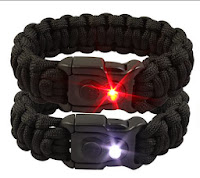
This is the one I've been wearing non-stop for about 3 months now. Its a simple braided paracord with a clip buckle. If needed, it will provide 9 feet of 550 para-cord.


http://bisondesigns.com/BUKaLight%20Paracord%20Bracelet

BukaLite bracelet

Same idea, but with the added feature of a micro LED flashlight in the buckle. Race director Josue Stephens has been wearing it out on the course while preparing his event and on various outings since.


http://bisondesigns.com/Flint%20and%20Steel%20Survival%20Bracelet
Flint and Steel

My favorite! What a name ;) The Flint and Steel is not only a bracelet, but also a knife and a fire-making kit. The loop buckle is actually the handle of a micro-knife that is buried in the paracord, and the toggle is a 1'' flint. Unbraided, the bracelet provides 15 to 17 feet of para-cord


http://bisondesigns.com/Survival%20Pod


Survival Pod

This is the most bang for the size. You get a serrated and smooth double-edge micro-knife, a fire-making flint, 6'' of tinder and 3'' of duct tape, just enough to patch up a wound or a tear in your gear. All that wrapped in 4 feet of bright orange-colored para-cord.


Analysis
It's pretty simple; Bison gear works, and it stays tight even when you carry it in everyday outings. It needs no maintenance and offers peace of mind to you and your loved ones by knowing that, if push comes to shove, you can count on a compact survival kit that just might tip the balance in your favor in a critical situation.

Conclusion
Considering the retail price and the wide variety of products offered, there is no reason for an outdoor enthusiast to not get at least one Bison accessory. They are ultra-compact, easy to carry and can help you get out of trouble when it counts the most.

High points
  • Rock solid
  • Stays tight
  • Affordable
  • Can be re-braided

Low points
  • Kits with knives cannot be carried on airplanes


The equipment for this personal review was supplied by Bison Designs free of charge, without any conditions.

August 29, 2013

Review : Bison Safety Bracelet

  • Type : Utility / Survival
  • Use : Any outdoor activity
  • Price : $10

Introduction
I meet a lot of runners in my travels, so I get the chance to talk about and check out a lot of gear. While on a run last week, I mentioned I carry an emergency kit in the bladder pouch of my running vest. A runner then told me “I don’t, but at least I have a Bison Bracelet”. Naturally, I got curious.

Bison products are made of braided para-cords, which you can undo in case of trouble. The bracelet, when completely undone, measures 10 to 12 feet depending on the wrist size you chose (small to large). They feature all sorts of colors, from straight black to flashy fluo.

Trail Test
I bought a bracelet and started wearing it both casually and on my trail runs. Although the braided cord makes it a little thick and rigid, it is light enough that you will forget you're wearing it. The plastic clip system lets you put it on and take it off at will, which means you can wear it only when you go out to play. It is unaffected by sweat and I got it wet a couple times and it stayed in perfect shape.

Analysis
I think the Bison bracelet is an awesome concept for anyone who ventures out in the wild. It can be used as-is on your wrist or as a strap to hold gear on a backpack. Two clipped together would make a great dog collar, too. And if you ever get in trouble while on an adventure, you simply undo the para-cord and use it to fix gear, as a tie-down, replacement laces, for first-aid or any other situation. At $10 a piece, you won’t fret at using it, either.

Conclusion
Bison products are the kind of equipment any serious outdoors person will want handy. They are cheap, solid, won’t take any space in your backpack or running vest and could get you out of trouble and even save your life in an emergency. Knowing how trail runners hate to bring extra weight and bulk on their runs in the woods, this is one piece of gear even the most minimalist person out there can afford to bring. It’s wearable safety.

High Points
  • Inexpensive
  • Sturdy
  • Won’t take any space in a backpack or vest
  • Can make a real difference in an emergency

Low points
  • Some might find it thick
  • Once you open it, you’ll need a new one
    UPDATE : Actually not true, see comments below

August 27, 2013

5 Trail Running Safety Tips

El Capitan at the trail head.
Notice the white paper on the sun shade;
it says the number of runners,
the name of the trail(s) and gives
an expected time of return.
Like every runner, I get very excited when I think about going out on a new trail. It is one of the best adventures, as I never know what I’m going to get, where I’m going to go and what wonders I will see. So, of course, I jump at every occasion to venture out in new places.

When my friend Micah disappeared in the Gila wilderness, the worst of the wait was to imagine him out there, probably badly injured, shivering to death in his running shorts and t-shirt at the bottom of some cliff or ravine. Even if it turned out that he suffered a heart attack and died almost instantly – and, thankfully, painlessly – I will never forget how powerless and desperate I felt at the idea that he was lost, somewhere, with only the clothes on his back.

Since that day, I’ve never hit a trail without carrying at least some safety equipment and taking some basic measures in case something goes wrong. I’m not necessarily talking about my weekly run at the local park where I know other runners and hikers will be out there and professional aid is available close by. Although it’s not a bad idea to always have some safety, I am also a runner and I’m not going to burden myself if I don’t need to. But every time I go out on a run in a more remote area, alone, or on a new trail, I always take the following precautions.

1. Emergency survival
If you’re going to take only one piece of safety advice from this post, take this one. Bring a survival kit with you. It doesn’t need to be big and bulky and there are some very good products out there for minimalists like us runners. Your kit needs to have at least a safety blanket, and I recommend having the sleeping-bag type which will keep you way warmer. You also want some matches, or a lighter, or at least some fire starter. Duct tape is a must and takes almost no space; you can even roll it on a small pen or your tube of electrolyte tablets. Extras can include an ultra-light knife, first-aid material, water purifying gear or tablets, a signaling mirror and a high-pitch whistle.

2. Leave a trace
Tell someone where you’re going and for how long. If you just don’t know, say it anyway. “I’m going to go wander around the Mesa Trail” is way better than no information at all. You have no one to say it to? Post it on Facebook or Twitter. Your running friends will be happy to know you’re out and they will know where you went. When you get to the trail head, leave a paper on your windshield saying the time you left, the direction you took and the time you expect to be back. It takes about a minute to do, will make any search & rescue attempt easier and could save your life.

3. Be ready to face the cold
Even in the warmest areas, it gets cold at night. Should you be stranded somewhere after the sun sets, it will get cold and you will suffer hypothermia. Also realize that the clothes you run in will be drenched in sweat, hence completely useless if you need to stay warm. Bring a pair of arm warmers, a light rainproof jacket and a Buff. These three items will fit any running backpack, vest or even waist pack, and they weight next to nothing. If you want extra safety, add a pair of lightweight pants or tights.

4. Pack food and drinks
You already know that you need to fuel on the run. Make sure you bring extra food when exploring a new area, and never keep going past your last third of fluids. Getting dehydrated and / or starved on the trail will have you struggling over obstacles you usually fly over. And if you get stranded or lost, you will be happy to have the extra fuel at hand. You might also have to deal with running partners who didn’t bring or forgot their own fuel, and save their butts :)

5. Mark your way
If you’re running a trail for the first time, more so in remote areas, and come at a trail crossing, stop and look. If the trails are marked, make sure you follow the right one. If they aren’t, pick a couple rocks or some sticks and shape an arrow on the ground. You can choose to make it point forward or back, just make sure you are consistent. Tracing the arrow on the ground is an option, but it’s not ideal as rain or even wind could erase them. Even if you have a GPS, these little markings could become very useful if you run out of batteries or have a breakdown. Of course, remove your arrows on your way out.

These five little things could make a difference if you get in trouble. They are not complicated and constitute healthy habits to take when you go out on an adventure. I hope you never need to spend a cold night on the trails, injured, but if you do, you’ll be happy you were prepared for the situation and will not freak out, alone, suddenly realizing you’re stranded, starving, cold, and no one knows where the hell you went.