Showing posts with label Gear. Show all posts

September 20, 2017

Review : Merrell Trail Crusher

  • Type : Neutral
  • Use : All-terrain
  • Price : $100

Intro
A couple weeks ago, if you’d asked me whether a jack-of-all-trades, all-terrain shoe was fit for trail running, I would’ve said no with quite a bit of assurance. Pretty much any shoe of that type that I’d seen before presented the same problem; an outsole too stiff and hard, designed to resist the wear of pavement, which made it unfit for the trails, where grip is key. That was until I tried the Trail Crusher.

Merrell has been making some excellent running shoes, with models such as the Bare Access and its Trail version (probably one of the very best trail running shoes made in recent years, in my opinion). Lately, they had seemed to have gone the maximalist route, with shoe models offering more and more stack height and cushioning, as seems to be the trend these days, and which was a huge disappointment to all the neutral-type shoe enthusiasts.

Well, it seems they are back on track with the Trail Crusher, with a reasonable cushioning of 18mm to 14mm, heel to toe and a drop of 4mm which should suit a large swath of runners. Although not the lightest of shoes, they kept the weight down to a decent 12oz and the shoe does feel a little heavy when you weight it, but that feeling disappears when you actually put it on.

Road test
I started testing the Trail Crusher on asphalt, as it is my personal nemesis. The hard surface kills my knees and requires me to use more cushioning than I’d like, making my choice of road shoe even more tedious and difficult. I want nothing to have with motion control or density variations in the sole, which even further limits my choices.

The shoe felt light and nimble, and as the miles piled up, provided enough protection against shocks to make me feel comfortable for going a little longer. In fact, I started to think that the Trail Crusher, despite its name, would probably turn out to be much more of a road runner than anything else.

Trail test
Then I headed for the trails. Although admittedly they were not the most technical, they still offered some roots, uneven footing, some loose rocks and various other hazards requiring at least some level of grip and agility. I was very pleased to find out that the outsole’s design, which doesn’t really look like a hardcore nubby trail shoe, actually works really well and retains surprising proprioception for a relatively-cushioned shoe. The bubble-looking tread concept has probably been borrowed from the hiking department, as I’ve seen very similar-looking soles on Merrell products before. My only worry is how the Trail Crusher will retain its grip with the eventual wear of the oval shapes, but that remains to be seen.

Analysis
With its decent flex, reasonable weight and no-nonsense design, it seems that the Trail Crusher has successfully combined the requirements to be both a road and a trail shoe, which is quite a feat, and excellent news for budget-weary runners who enjoy a variety of terrains. Merrell’s signature wide toebox and some reinforcements at both ends of the upper complete an intelligent design and impressed me almost as much as the Bare Access model, enough so that I will be buying extra pairs just in case they would choose to stop production before my first pair wears out.

Conclusion
If you run on multiple surfaces, enjoy light neutral shoes without excessive cushioning and don’t want to own 15 different models of footwear to cover every type of terrain you run on, the Trail Crusher is an excellent contender, very well-designed and reasonably-priced. As far as all-terrains go, it doesn’t get much better than that.


High points
  • In line with Merrell’s previous designs like the Bare Access
  • Sole design actually works on all terrains
  • Pretty good pricing

Low points
  • Not sure how the grip will be when the outsole starts to wear out
  • Heel cup is surprisingly high and reaches above usual on my Achilles tendon


July 17, 2017

Review : Enduroforce

  • Type : Nutrition / hydration
  • Use : Running fuel / tonic
  • Price : 2,29$ ea. / 22.99$ box

Introduction
When you’re an endurance athlete, it’s really hard to carry your healthy eating habits into your running fuel and hydration needs. A vast majority of foods, drinks and supplements use highly-refined sugars, such as maltodextrin or glucose-fructose, to trick your body into high gear. For health-conscious endurance enthusiasts, this is less than optimal, to say the least.

Thankfully, there are a growing number of endurance fuels which use only natural ingredients, starting of course with Mas Korima, a collaborative enterprise I’m very proud to be a part of. There are also other new and innovative products out there, and Enduroforce is definitely one of them.

Enduroforce uses maple syrup and spirulina, mixed with sea buckthorn and ginseng. That’s it. Four natural ingredients, nothing else. I like that a lot and, after sampling the product, got enthusiastic about its effects, too.

Testing
The idea behind Enduroforce is to be a tonic, a natural stimulant that forgoes the use of caffeine and taurine and that helps maximize endurance. The ingredient mix is rich in antioxydants, vitamins and minerals, comes in a tiny dose of 15ml and still packs 40 calories and a gram of protein.

Upon trying it the first time, I was expecting a boost comparable to the use of a gel, or maybe like a shot of espresso. This is not at all the effect of the product. It didn’t change much in my intensity; what it did is to increase my awareness and focus, and mostly to rid me of the impression of fatigue while I’m running. It’s a subtle effect, but an important one when going on multiple-hour endurance runs.

Compared to a straight shot of maple syrup (which is what I now use as a gel replacement as well as the sweetener for my pinole mix), Enduroforce doesn’t pack a big punch, and I don’t think it’s its intended purpose either. As a tonic, it brings a balanced shot of stimulation, nutrition and supplementation that really starts to shine in the long run.

Taken 45 minutes before effort, then subsequently about every 2 hours, Enduroforce maintains my energy and focus and decreases my perceived effort without playing yo-yo with my sugar levels.

Analysis
Taste-wise, Enduroforce takes a bit of getting used to. Personally, I don’t mind an “exotic” taste, as long as it’s not too strong or pungent. I won’t go as far as saying Enduroforce tastes good, but I got used to it pretty quickly and the fact that it’s fully natural weights a lot in my personal balance.

My biggest qualm about it is the strange little package it comes in. It’s a small plastic tube with a break-off tip which isn’t easy to manipulate at first. Furthermore, when you’ve used the tubes, they often drip into running vest’s pockets and leave a sticky little mess. Lastly, I’m not a big fan of single-use plastic and would love an option of a large container and reusable screw-top type “shots” to save on trash and skip the mess all at once.

Conclusion
In my opinion, Enduroforce is a good element in an endurance nutrition mix for the health-conscious athlete who wants to steer clear from the chemicals and highly-processed compounds that make up most fuels out there. Used side-by-side with your liquid and solid nutrition of choice (Andale! pinole and Korimalitas energy bites in my case), it can help you perform well without a nagging feeling of constant effort.

High points
  • Fully natural
  • 4 ingredients. Period.
  • A tonic that keeps you going
  • Mitigates fatigue and perceived effort

Low points
  • Break-tip containers are finicky
  • Empty tubes are messy
  • Single-use plastic


The material for this personal review was supplied by Leo Desilets / Enduroforce free of charge. Disclosure: I am part of Enduroforce’s ambassador team.


May 26, 2015

Review : Skechers GoRun Ultra


http://www.skechers.com/style/53915/skechers-gorun-ultra/
  • Type : Maximalist
  • Use : Road
  • Price : $90-$110

Introduction
Sometimes, I get desperate. I’ve been experiencing a weird knee pain every once in a while for more than a year now, and I’ve never figured out what causes it. One thing for sure, I know asphalt doesn’t help it. To get rid of my problem, I’ve followed about every piece of advice I’ve been given, except maybe for one…

“Run in Hoka’s, man”.

No way. That goes against everything I think to be true. But then again, I have to admit I’ve seen tons of runners, some very good ones, too, use them and harp about the benefits of super-cushioned shoes. So right after my last asphalt adventure, I had the Ottawa Marathon coming up and I figured, this is a good a time as ever to see if maximalism is for me or not.

I had a pair of Skechers GoRun Ultra lying somewhere in my closet. They’d been sent to me to be reviewed about a million years ago (sorry, Skechers!) and I’d never got the nerves to take them out for a spin. Now with a bum knee still hurting from the last time I ran on asphalt and a road marathon to go, I thought the time had come.


Road test
I showed up at the marathon starting line in my brand-spanking new, never-before-worn bright red Ultras, feeling like I was wearing moon boots. The cushioning is so massive, it actually makes you taller. Any notion of proprioception is erased and flex also becomes a distant memory. I felt like I was thumping around with my feet shoved in a pair of giant marshmallows.

The gun went off, and my first thoughts were to try and maintain as much of a forefoot strike as I could. Pretty much impossible. This is a midstrike-at-best situation; there’s over 40mm of material between your foot and the ground. The sole feels square and flat, which is not unpleasant, even if it doesn’t “roll forward” like I expected it to with its monstrous 14mm heel-to-toe drop.


Analysis
You have to understand that I come from a minimalist background, running in shoes that keep my feet close to the ground and as close to zero-drop as possible. So for me, wearing the Ultras was overwhelmingly different and an experience for which I don’t have a lot of reference points. I have to say that they did an admirable job of mitigating the pounding from the asphalt and absorbing any irregularity in the ground under me. I couldn’t quite shake off the feeling of running in moon boots, but that didn’t bother me much for most of the course. As the miles piled up, I was increasingly pleased with how fresh my legs felt.

Straight elongated leg,
toes pointing up...
Awfully looks like heel striking.
However, this massive shoe quite literally transforms the way you run. You have to basically yank your leg up using your hip muscles. I’m used to pushing off with my toes and landing lightly on the front of my foot; while wearing the Ultra, you kick your leg up and thrust it forward, elongating your stride. I’ve seen some race pictures where I quite obviously heel strike, which is consistent with the slight wear pattern that formed under the shoe. That’s a big worry on the long term.

I managed to finish my marathon with a less-than-optimal body, a finish I attribute at least in part to the thick protection of the Ultra’s Resalyte cushioning. The pain and unease I felt toward the end, I’m pretty sure, can be attributed to the radical difference in running form, to which my various next-day muscle sores can attest.

Analysis
It’s hard for me to see the Ultra as a usual, every day running shoe. I think it can be useful to the runner who wants a shoe for every situation and who contemplates running long distances on pavement when previous similar experiences have proven painful. I think it is worthy of noting that it’s really hard to run fast in these shoes because of their inherent design philosophy. I’d add it might be a great mitigation shoe for someone who’s heavier and starts being active again and / or experiences pain, although I remain convinced pain should be a guide in respecting one’s body, not something to be masked by technical solutions. But that’s another debate.


Conclusion
While Resalyte once again proves its worth, I think there is such a thing as too much. However, it’s obvious to me I probably would’ve had a very hard time finishing my marathon if I’d wore anything that resembled my usual shoes, because asphalt just hurts. The impact absorption capabilities of the thick, cushioned GoRun Ultra will, ultimately, help you last longer on unforgiving hard surfaces. So I’m left with a conundrum; stop running long distances on pavement… or wear maximalist shoes when I do.


High points
  • Resalyte. Like, a metric ton of it.
  • Obvious impact mitigation
  • Very reasonable weight, at 9 oz
  • More than half the price of a pair of Hoka’s


Low points
  • 14-mm drop is way too much
  • Outsole lugged design is questionable; this can’t be a trail shoe
  • Will change your running form if you are a forefoot runner


The equipment for this personal review was supplied by Skechers free of charge, without any conditions.

April 21, 2015

Review : Inov-8 Roclite 295

 
    • Type : Neutral
    • Use : Trail running
    • Price : $120-$130

    Introduction
    This is the third Inov-8 shoe I get to run in, and the second I review after the Race Ultra. I've always been impressed with the Inov-8 feel and its extreme expression; when I wear these shoes, I feel like a pro! The combination of grip and responsiveness is only matched, in my opinion, by a few top-of-the-line trail shoes such as the now-defunct Kinvara Trail from Saucony or my beloved (and also now-defunct, dammit) Altra Lone Peak 1.5.


    Trail Test
    This time around, the shoe feels light and quick, much more like the 235's I'd tried the first time. Unlike the Ultra, which definitely feels like it was made for a more cushiony ride over rough terrain, the 295 brings the aggressivity back while maintaining a great level of comfort. The shoe feels slim and long, with a lot of room at the tip but not so much on the side. When you lace up, you can feel how plush the upper is and I immediately thought how great that feeling must be while changing shoes in the middle of a long race.


    Analysis
    While certainly not a minimal shoe, the 295 doesn't overdo it and remains swift and nimble. The extra material between your foot and the ground becomes a great advantage if you're going to run long on terrain that switches from trails to pavement, for example, or if you're looking for a good overall winter running shoe. The grip is as good as always, with the outsole material soft and sticky. If you're looking for a firm grip in a comfortable shoe, this is it.

    Conclusion

    While this is pretty much the bulkiest shoe I'd wear out there, I have to say there's a lot of things the 295 does well. The feeling of sturdiness and protection you get can be a great plus for beginning trail runners or to get yourself back together after some hard distance on rough trails. The 9mm drop is the only thing I wish was different; why does it have to be so steep? I'd give it all A's if it had, say, 4.

    High points
    • Excellent grip as always
    • Nimble and swift despite added material
    • Super comfy

    Low points
    • 9mm drop is just too much
    • Tiny laces make it real easy to overtighten the shoe


    August 7, 2014

    Review : Skechers GoMeb Speed 2

    http://www.skechers.com/style/53925/skechers-gomeb-speed-2/bkgr

    • Type : Neutral shoe
    • Use : Road running
    • Price : $115


    Introduction
    The GoMeb Speed 2 is the next generation in the GoMeb series. The shoe is designed with competition in mind and feels like a more cushioned version of a traditional racing flat. Like its predecessors in the “Go” series, the outsole features the pod system, which is intended to offer some slight motion control without the use of complex mechanisms. The presence of the signature “stability plate” inside the sole almost questions if this shoe can be deemed neutral, but the overall lightweight and flexibility leave little to ponder about the GoMeb’s minimalist design philosophy.

    Road test
    When I tested the first model, I’d taken the guess that the GoMeb would be suitable for long runs on roads, which sadly I couldn’t try for myself since my feet inexplicably changed sizes last year. So this time around, I took the GoMeb Speed 2’s exclusively on longer runs, namely a 30K daily commute to and back from work.

    The speed sensation and lightness are definitely the key elements of the shoe. I also very much liked the new construction of the upper, which feels like they applied a flexible varnish on the pressure points to make them stronger. Add very minimal stitching and you get a shoe that is ultra light, ultra flexible and very comfortable.

    Analysis
    There are really good things about Skechers that apply to almost all their products. The Resalyte material is the most obvious; a feather-light sole material that has just the right bounce without taking anything away from total flexibility. In this perspective, the GoMeb delivers fully.

    The pod system, called GoImpulse sensors, however, had a strange effect on my feet. It seemed some of the pods would push up through the sole against my arches and cause some aches over longer distances (60K and beyond). This was confirmed when I wore the GoMeb’s daily on a recent trip to Europe, which involved long hours of walking and standing.

    Although I think the pod system is clever and well-placed in more supportive models like the GoRun, I’m not sure what it delivers in a shoe that has speed in its DNA. By definition, if you buy and use racing flats, you don’t require the shoe to have any form of motion control. Stability should not be a component of a racer; flex and freedom should be put forward.

    With that said, I think the GoMeb Speed 2 is an excellent shoe for shorter road runs, in the 5K to half-marathon range. It has more material under your foot than a typical racing flat, which adds a welcome addition of comfort without feeling any more bulky. I will definitely keep and use it for fast road races and shorter daily commutes.

    High points
    • Resalyte, as always
    • Simply built, yet very comfortable
    • Comfier than a pure racing flat
    • Can’t argue with the price tag

    Low points
    • The use of the pod system is questionable


    The equipment for this personal review was supplied by Skechers, free of charge, without any conditions.

    April 29, 2014

    Review : Altra Lone Peak 1.5


    • Type : Neutral
    • Use : Trail
    • Price : $115-130
    Intro
    I discovered Altra shoes while having a couple drinks and snacks at my friends the Miller's after a run. We were talking about the excesses of the “maximalist” movement, where shoes get more and more padding to appeal to the tired feet of long distance runners. Someone produced a pair of Altra Lone Peaks to make a point that there were shoes out there which offered significant padding, but followed some of the basic principles of “minimalist” running, too. No need to say, they got my attention.

    First test
    I had a long run scheduled shortly thereafter and received my Lone Peaks on the day I was leaving, which left no room for second thoughts. If I was going to wear those shoes in my Grand Canyon rim-to-rim-to-rim adventure, I had to be dead sure they wouldn't cause issues. The day before our traverse, we went out for a couple-hours hike down the south rim; that was my chance. I tried out the shoes, hiking for several hours, and was very pleased with the comfort, super wide toe box and soft ground feel. I was convinced enough to wear them the next morning.

    Long-distance trail test
    We started our adventure before daylight, which means some unsure steps along a very steep downhill in the semi-darkness. Immediately, I felt at ease in the Lone Peaks. They are grippy and feel very secure, yet their soft sole leaves all the room you want for foot flexing and ground feel. Being zero-drop, they didn't alter my running form in any way and their low weight, impressive considering the amount of material in the shoe, made me feel as quick-stepped and light as in any other, more minimal shoe I usually wear.

    Not too shabby for a test lab :)
    But the Lone Peaks started to really shine when the miles piled up. Beyond twenty miles of fast downhills and gruelling climbs, I expected my feet to start getting tired and beat up. Not at all. The cushioning is thick and soft, and my feet felt so fresh that it was hard to believe, considering the terrain we were navigating.

    More miles and more fatigue, and still the shoes felt great. I was a little worried that the very wide toe box would cause significant inner friction. On the contrary; the ample room left my toes free to move and I didn't feel any hot spots. I didn't have to lace too hard either, so no blood circulation issues, even when my feet inevitably swelled up from the hours of beating down the dirt paths.

    I emerged back on the south rim over sixteen hours after I had started, and couldn't repress a wide smile when I took the Lone Peaks off to find no blisters whatsoever, no hotspots and no bruising. This shoe, I tell you, is an absolute keeper.

    Analysis
    Altra has definitely found an equilibrium between comfy cushioning and firm ground feel. The Lone Peak doesn't go over board like the ultra-cushioned extravagant Hoka, yet provides such a smooth ride that you can wear it for hours on end and still feel great, protected and close to the ground all at once. The soles are grippy and firm, never slipping, sliding or rolling. I even tried a couple pretty stupid steps on sketchy scree, wet rocks and other perils and I never lost grip. I felt confident and could focus more on the beautiful nature that surrounded me, instead of wearily scanning the trail to pick my way at every step. I finished a pretty gruelling adventure with fresh feet, and a huge smile on my face.

    Conclusion
    The Altra Lone Peak is an awesome trail shoe perfectly fit for long distance running on a wide variety of terrains. If you train in lightweight minimal shoes and are looking for a comfier ride for your trail ultras, look no further. The wide toe box lets your toes move freely, while the upper and the lacing fit snugly around your foot. The grip is perfect and actually added to my confidence on the trails. The cushioning is what really sets this shoe aside (and I would say above) the competition for its fantastic comfort while not taking anything away from ground feel and flex, which really made me wonder how I would ever run another ultra wearing anything else.

    High points
    • Thick, comfy, excellent cushioning
    • No compromise on flex and ground feel
    • Zero-drop conception doesn't alter your running form
    • Light weight
    • Neat extras, like a built-in velcro attachment for gaiters

    Low points
    • Probably too padded for an everyday trainer


    November 27, 2013

    Tribesports Gear Is Here!


    FlintLand's content partner Tribesports has successfully completed its Kickstarter campaign and is launching a brand new line of technical apparel for runners and outdoors enthusiasts. Their idea is to offer top-of-the-line clothing at a reduced price by skipping the middle men, doing no paid advertisement and foregoing the elite sponsorships that cost tons of money. The result: an affordable line of quality gear.

    In the coming months, FlintLand will be among the first blogs to review some of that gear, putting it to the test on roads and trails. In the meantime, here are some shots of tribe members hard at work (playing) in their Tribesports gear :)


    October 29, 2013

    Review : Bison Survival Products

    My Survival Pod follows me everywhere

    • Type : Survival gear
    • Use : Any outdoor activity
    • Price :
      • BukaLite $22.00
      • Flint and Steel $28.00
      • Survival Pod $17.00


    Introduction
    I discovered Bison Design products at the beginning of my sabbatical, while running with friends. The idea is simple, yet clever : you wear gear made of sturdy para-cord that you can unbraid and use if you get in trouble. After trying out the classic safety bracelet, Bison offered me to take some of their other accessories for a real test in the Texas outback; the Hunter Gatherer Survival Ultra.

    Test
    The gear check at the Hunter Gatherer was not as strict for ultra runners as it was for survivalists, so I clipped the Survival Pod on my hydration vest and carried it with me without a worry. I wanted to see how well it would resist to all the swinging and banging of a 50K outing, most of which is off-trail bushwhacking through thorny bushes and cacti. I needed to make sure the pod would stay braided tight and not open up while on the run.

    For clarity's sake, here's a rundown of the various pieces of Bison Gear that were brought on the trails :

    http://bisondesigns.com/Side%20Release%20Cobra%20Bracelet%202%20Tone 

    Side Release Cobra Braid bracelet

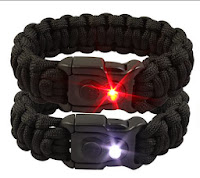
    This is the one I've been wearing non-stop for about 3 months now. Its a simple braided paracord with a clip buckle. If needed, it will provide 9 feet of 550 para-cord.


    http://bisondesigns.com/BUKaLight%20Paracord%20Bracelet

    BukaLite bracelet

    Same idea, but with the added feature of a micro LED flashlight in the buckle. Race director Josue Stephens has been wearing it out on the course while preparing his event and on various outings since.


    http://bisondesigns.com/Flint%20and%20Steel%20Survival%20Bracelet
    Flint and Steel

    My favorite! What a name ;) The Flint and Steel is not only a bracelet, but also a knife and a fire-making kit. The loop buckle is actually the handle of a micro-knife that is buried in the paracord, and the toggle is a 1'' flint. Unbraided, the bracelet provides 15 to 17 feet of para-cord


    http://bisondesigns.com/Survival%20Pod


    Survival Pod

    This is the most bang for the size. You get a serrated and smooth double-edge micro-knife, a fire-making flint, 6'' of tinder and 3'' of duct tape, just enough to patch up a wound or a tear in your gear. All that wrapped in 4 feet of bright orange-colored para-cord.


    Analysis
    It's pretty simple; Bison gear works, and it stays tight even when you carry it in everyday outings. It needs no maintenance and offers peace of mind to you and your loved ones by knowing that, if push comes to shove, you can count on a compact survival kit that just might tip the balance in your favor in a critical situation.

    Conclusion
    Considering the retail price and the wide variety of products offered, there is no reason for an outdoor enthusiast to not get at least one Bison accessory. They are ultra-compact, easy to carry and can help you get out of trouble when it counts the most.

    High points
    • Rock solid
    • Stays tight
    • Affordable
    • Can be re-braided

    Low points
    • Kits with knives cannot be carried on airplanes


    The equipment for this personal review was supplied by Bison Designs free of charge, without any conditions.

    October 10, 2013

    Review : Skechers GoRun Meb Speed


    • Type : Neutral shoe
    • Use : Road running
    • Price : 110$

    Introduction
    Meb Keflezighi is seriously fast. He's been working with Skechers for a while now, first in designing the GoRun and then his own signature shoe, which resembles a racing flat version of the typical Skechers models. The shoe is low, super light and looks like it's on fire. Will it make me faster?

    Road Test
    My favorite Skechers shoe, design-wise, was the GoBionic. I thought it offered the lightest, fastest feel of the family - until I tried the Meb Speed. This shoe is very, very light, but it offers some interesting features which add a certain stiffness to it that I really like.

    I took my Meb's out for several shorter runs on road and concrete pathways. They are light and feel fast, just like agressive racing flats. They offer a little bit more cushioning, too, which makes me thing they would be a better choice for a longer run, like a road ultra.

    Once again, the Resalyte sole material delivers fully, as it offers great flexibility and proprioception, yet cushions your foot just enough for great comfort. The overall weight of the Meb Speed is a featherly 6 oz and the upper fabric feels breathy and light.

    The outsole features a pod system called GoImpulse Sensors that resembles other Skechers models, but is much lower and less in the way. The big difference with the Meb Speed is the «stability plate» located under the arch, which attracted some negative comments from other runners and bloggers. In all honesty, I can't even feel it; the only thing that bugs me a little bit is the gaping hole under the plate, which acts as a rock sucker. But other than that, the shoe feels awesome.

    Analysis
    The Meb Speed is a fine addition to Skechers' line of running shoes. It offers the best of a racing flat while still featuring minimal cushioning for long road rides. The fit is perfect and the shoe feels fast and solid. This is definitely my new shoe of choice for road racing. On a slightly irrelevant sidenote, I wore my Meb Speed's for a desert ultra marathon a couple weeks ago... and they are not a trail shoe.


    High points
    • Resalyte. 'Nuff said.
    • Light and fast
    • Solid feel

    Low points
    • Outsole hole is a rock sucker


    The equipment for this personal review was supplied by Skechers, free of charge, without any conditions.


    August 29, 2013

    Review : Bison Safety Bracelet

    • Type : Utility / Survival
    • Use : Any outdoor activity
    • Price : $10

    Introduction
    I meet a lot of runners in my travels, so I get the chance to talk about and check out a lot of gear. While on a run last week, I mentioned I carry an emergency kit in the bladder pouch of my running vest. A runner then told me “I don’t, but at least I have a Bison Bracelet”. Naturally, I got curious.

    Bison products are made of braided para-cords, which you can undo in case of trouble. The bracelet, when completely undone, measures 10 to 12 feet depending on the wrist size you chose (small to large). They feature all sorts of colors, from straight black to flashy fluo.

    Trail Test
    I bought a bracelet and started wearing it both casually and on my trail runs. Although the braided cord makes it a little thick and rigid, it is light enough that you will forget you're wearing it. The plastic clip system lets you put it on and take it off at will, which means you can wear it only when you go out to play. It is unaffected by sweat and I got it wet a couple times and it stayed in perfect shape.

    Analysis
    I think the Bison bracelet is an awesome concept for anyone who ventures out in the wild. It can be used as-is on your wrist or as a strap to hold gear on a backpack. Two clipped together would make a great dog collar, too. And if you ever get in trouble while on an adventure, you simply undo the para-cord and use it to fix gear, as a tie-down, replacement laces, for first-aid or any other situation. At $10 a piece, you won’t fret at using it, either.

    Conclusion
    Bison products are the kind of equipment any serious outdoors person will want handy. They are cheap, solid, won’t take any space in your backpack or running vest and could get you out of trouble and even save your life in an emergency. Knowing how trail runners hate to bring extra weight and bulk on their runs in the woods, this is one piece of gear even the most minimalist person out there can afford to bring. It’s wearable safety.

    High Points
    • Inexpensive
    • Sturdy
    • Won’t take any space in a backpack or vest
    • Can make a real difference in an emergency

    Low points
    • Some might find it thick
    • Once you open it, you’ll need a new one
      UPDATE : Actually not true, see comments below

    July 25, 2013

    Review : Camelbak Marathoner Vest

    • Type : Hydration
    • Use : Road / trail running 
    • Price : $100

    Introduction
    As I try and test more hydration vests, I come to realize that more isn’t necessarily better. In the increasingly crowded space of hydration products, it seems like every company out there has come with a solution of their own. Don’t get me wrong, some of them are really good, especially if your budget is unlimited, but I’ve come to find it’s not the exotic, fancy features that make a really good hydration vest.

    I’ve said it before, my usual point of reference when testing a vest is the Nathan Endurance, which I about wore to shreds. It convinced me that a good vest needs to fulfill certain imperatives, such as:

    • Quick, no-hassle bladder management (filling, fitting, cleaning)
    • No or minimal swinging and sloshing
    • Leak-proof
    • Lightweight
    • Optimal storage

    Even though Camelbak's Marathoner vest felt, at first glance, like the little brother of the Ultra LR, I gave it a good couple long-distance runs in various environments to see if it was up for the task.

    Road and trail test
    The first obvious difference between the Marathoner and the Ultra LR is bulk. At two-thirds of the weight, the Marathoner actually feels like less than half of the bigger, more backpack-like Ultra. It uses the simplest of designs; two shoulder pads connected to the bladder by a single v-shaped adjustment strap. The 2-liter (70 oz) pouch itself is also a standard, upright design, with the signature huge screw-in cap that makes all Camelbak bladders instantly recognizable.

    Adjusting the vest is key to making sure it stays comfortable and won’t swing around. This is done by removing the bladder and sliding the shoulder pads in or out, then securing them with Velcro bands. The double frontal straps can be adjusted by sliding them along most of the length of the shoulder pads, then adjusting the clips. I think there is enough room here to fit any chest type, a feature female runners of all sizes should very much enjoy.

    Even though the Marathoner sheds the two belt pockets found on the Ultra, it offers ample storage space with its two very large chest pockets, which can easily accommodate extra bottles if needed. The genius of the Marathoner resides in the mesh fabric that covers the shoulder straps. A slit in the fabric allows you to slide anything you want inside the shoulder pads, from extra gels to arm warmers to a set of keys (and they won’t jiggle).

    Analysis
    Wearing and using the Marathoner on the run is a breeze. It sits very lightly on the shoulders and doesn’t swing around. It features two clips to hold the drinking tube along the right shoulder pad, but I prefer to use only the upper clip, then run the tube across my chest and hold the bite-valve with the bungee cord on the left pad.

    I never suffered any shortage of storage space, even in longer runs up to 20-25 miles. The mesh pocket on the back can even carry an extra piece of clothing if needed, which makes it suitable for trail runs in changing environments. When running in the city at night, I also appreciated the multiple reflective bands in the front and the back of the vest.

    Where the Marathoner really shines, in my opinion, is in the bladder management. I’ve said it before, the proprietary Antidote system is probably the best in the industry, with its click-valve to remove the drinking tube without any spills and its huge screw cap that anyone, even an exhausted ultra runner in their darkest hour, can easily operate. Furthermore, since the Marathoner’s bladder is the standard, vertical type, it’s even easier to remove and replace than the “lumbar” version of the Ultra LR, which is sometimes too exotic for aid station helpers to quickly figure out and can prove a hassle.

    Conclusion
    I have come to like the Marathoner better than the Ultra LR, as it is simpler, lighter and offers plenty of storage for my needs, with the added benefit of being significantly cheaper. Whereas the Ultra LR is somewhat unique as a mix between a vest and a pack, I think that runners who have the luxury of owning both a vest and a running backpack will appreciate the lighter weight and simplicity of the Marathoner on their long runs, whether on the roads or trails.

    High points
    • Simple, efficient no-frills design
    • Excellent bladder and click-valve system
    • Multiple adjustments for an optimal fit
    • Clever mesh pockets along the shoulder pads
    • Very appealing price at around $100

    Low points
    • Maybe not as roomy as other, larger vests


    The equipment for this personal review was supplied by Camelbak free of charge, without any conditions.

    June 2, 2013

    Review : Camelbak Ultra LR Running Vest

    • Type : Hydration
    • Use : Long-distance running
    • Price : $130

    Introduction
    Camelbak and I go way back. When I started to run-commute, I opted for a SnoBlast bag to carry my stuff around and hydrate at the same time. Since it’s a downhill skiing / snowboarding bag, it seemed like an odd choice and many runners commented on it. When I wore it for my first ultra, people started telling me I needed a vest. I thought my SnoBlast did an awesome job, and although I still wear this bag every day for other purposes, I have to admit my world changed when I tried a hydration vest.

    My model of reference for hydration vests is the Nathan Endurance, which I have worn so much it’s half-torn apart. I have tried a couple other alternatives, but never found anything I liked. When Camelbak sent me a Marathoner and an Ultra LR, my eyes got set on the latter in an instant.

    Trail test
    I took the Ultra LR out for a first unforgiving test on a cold winter afternoon. Frankly, I didn’t think it would last more than 10 minutes in the sub-zero weather. I was very pleased to discover it didn’t freeze, as long as I blew back some air in the drinking tube. The vest itself felt comfortable and barely-there. The weight distribution at the very bottom of the vest makes it feel very light.

    Road test
    I took the Ultra LR on several long winter runs, but was curious to see how it would perform when warm weather would settle in and I’d ditch the extra layers of clothing. So when spring came, I made sure to bring it to all my longer races. I ran two half-marathons, a couple long runs on my own, a full marathon and a 50K ultra wearing it.

    Quick Link Tube Assembly System
    Analysis
    Definitely, the best part about Camelbak vests is the tube assembly. It starts with a coupling at the bladder that you only need to push the tube in to connect. When the tube is disassembled, the bladder will not spill or leak. This means you don’t have to undo the whole vest to get the bladder out and rince / dry it after your runs. It also means you can carry more than one bladder (say, in a drop bag) and swap them with a simple click of the drinking tube. Pretty awesome. But it doesn’t stop there. The bite valve is also very well-conceived, with a simple slit that opens up when you bite it. If you’re worried it might drip or get squeezed-open when transporting the vest, there is also a cut-off valve to ensure liquid flows only when you want it.

    The Ultra LR is the roomiest vest I’ve ran in, with multiple front pockets and accessible mesh stashes over the straps where you can easily slip half a dozen gels, a Clif bar or two, your keys, a pair of arm warmers and a couple other small items. The belt portion also features two large waist pockets for even more storage that’s accessible while you run. The back of the vest offers a large mesh stash that will easily contain a light windbreaker or other pieces of gear you might need. It has a built-in whistle, which is an obvious safety feature, but moreover will allow you to tick a mandatory item off the equipment list of many mountain ultras.

    Bite valve with cut-off mechnism
    The shoulder harness and waist straps are fully adjustable and will fit runners of almost any size. Although there are neat “compression straps” for the bladder, I’ve never used them and question their purpose. The belt goes all the way from your right to buckle on your left side, which felt a bit awkward. Why not use double adjustments like everyone else?

    Space also comes at the price of weight. The Ultra LR is also the bulkiest vest I’ve ran in, and that difference is way more noticeable when running in warm weather, where it almost feels like a backpack with a lot of fabric touching your skin. It weighs in at over a pound, too.

    Conclusion
    The Ultra LR brings a lot of innovation to hydration vests with the unique lumbar bladder, the awesome valve and tubing system and the creative use of space for storage. I think it offers very interesting features, but would benefit to undergo a drastic weight and bulk reduction effort, which would bring lighter and more breathable fabrics, and reduce the contact points with the runner’s body. Overall, this is definitely a piece of gear I will use in my running.

    High points
    • Possibly the industry’s best valve and tubing system
    • Clever lumbar bladder puts the weight on your waist, not your shoulders
    • Extra roomy
    • Fully adjustable

    Low points
    • Feels bulky, more so in warm weather
    • Heavy at 1.15 lbs


    The equipment for this personal review was supplied by Camelbak free of charge, without any conditions.

    May 27, 2013

    Review : Skechers GoRun2

    • Type : Neutral
    • Use : Road running
    • Price : About $80-90


    Introduction
    This is the third Skechers shoe I get to review. The two previous models showed some promise, but also carried some flaws that prevented me from choosing to use the shoes after the review. The original GoRun was one of these models, so when I received a pair of GoRun2, I thought maybe I was in for a bit of the same.

    First impression
    The very first thing I did was flip the shoe and look at the sole to see if the “pods” were still there. Although there were still pod-like lugs, they did not look or feel like their oversized, protruding predecessors and were distributed differently around the sole. They resembled the rest of the sole pattern and went all the way around the forefoot area. Interesting.

    It also seemed to me that the shoe’s profile had been considerably reduced, although it kept its signature upward curve at the heel.

    Road test
    I did with the GoRun2 what I had with the original model; I took it out for a couple run commutes. Immediately after putting the shoes on, I noticed they had a very different feel, which was closer to wearing a light neutral shoe. No more feeling the slightly-elevated, slightly-supported arch that I had disliked in the GoRun. No more “tilt-backward” feeling from the curved heel, either.

    The slip-out insole got ditched early on
    I took my sweet time to test the shoe out, at first to make sure I wouldn’t get all sorts of weird aches as I would up the mileage. But I quickly realized the GoRun2 is a very different animal than the GoRun; it felt increasingly comfortable and performed very well, even in winter conditions.

    The only thing that went sideways (literally) is the insole, which was sliding out of the shoe as I ran, something I’ve never seen happen in any footwear. I was quick to throw the insole away, and I never looked back as the shoe is perfectly wearable without this mild annoyance.

    Long-distance test
    I grew fonder of the GoRun2 as I ran with it, and it became one of my first choices as a commuter. I also very much liked how the GoRun2 behaves when running fast, because I think it offers just the right amount of sole material to absorb the extra shock while remaining very light. My confidence in the GoRun2 increased enough that I decided to put it to an ultimate test; I wore them at the Ottawa Marathon yesterday.

    Since I began trail running and strayed further and further from the roads, I find it increasingly difficult to run long distances on pavement because the hard, regular surface takes a heavy toll on my legs and feet. It requires a clockwork-type movement repeated to infinity, as opposed to the irregular, side-stepping, root-jumping dance of trail running. Wearing the GoRun2 made it a breeze by reducing my fatigue and allowing me to run as hard as I wanted in the downhills without feeling the added shock to my lower body. And I have to add that, after testing 3 models of Skechers shoes, I have become a fan of Resalyte, the soft, yet solid sole material they use in all their models.

    Conclusion
    I think Skechers has finally built a shoe that is a serious contender in the road-running world and that should be considered by ultra road runners looking for a softer ride on their long distance outings. The GoRun2 is soft, flexible, light, roomy and breathable. As an all-around running shoe, I’d be hard-pressed to find it any major flaw. This is the one Skechers model I have included in my personal shoe selection and will continue running in.


    High points
    • Resalyte is simply one of the best sole materials I know
    • Roomy toebox allows for ample toe splaying
    • Surprisingly grippy for winter road running
    • Comfortable for both speed and long distance


    Low points
    • Just ditch that annoying insole


    The equipment for this personal review was supplied by Skechers, free of charge, without any conditions.

    March 20, 2013

    Review : Luna OSO

     
    • Type : Barefoot/minimal
    • Use : Trail running
    • Price : About $80-90


    Introduction
    I first became aware of Luna Sandals on my initial trip to the Copper Canyons. Seeing the Luna Boys coming down to run with the Raramuri, I thought this was a nice display of respect, but I also thought it was... crazy. But then I ran the last 10 miles with Scott Smuin at the end of the grueling ultra, and he seemed to be doing just fine in his huaraches – that is, no worse than anyone else at this point. I was amazed. He suggested I try them. I thought this was... crazy. Again.

    But then he sent me a pair of the Leadville model, which I tested and reviewed last year. Although I was, again, greatly impressed, I wasn’t entirely sure this was the best footwear to go trail running, at least not in the gnarly canyons, not when you're me and not when going at it for over 8, 9 or 10 hours.


    First impression
    I tried and fitted my OSO’s in December at The Running Event, a trade show we attended with the Luna crew. After a bad run the day before, where I had turned an ankle, I wasn’t sure it was a great idea to go dancing on the pointy, sharp rocks of Austin’s Green Belt with sandals. I was expecting to hike much more than anything. To my astonishment, I started running easily and with growing confidence, and even ended the day chasing the Luna guys up a dry, rocky riverbed. Wow.

    But that was 10k, and that was Texas. I live in Montreal, I run ultras and I get cold easy. On a good year, I don’t think I’d get more than 6 months of running in sandals, so I thought they were really neat, but honestly not something I could ever use as footwear in any trail event. Then I traveled to the Copper Canyons again.


    Trail test
    On an easy day after a long run in shoes, I took a couple people for a hike up El Naranjo, which is a part of the UMCB course. It was hot and I was lazy, and I didn’t feel like wearing shoes. I knew the OSO’s were solid, so I decided to wear them for the 4-5 hour walk. I couldn’t help but try a couple running stints with them on the single track going up, and I started playing around, running, in the steep gnarly downhills. They held very well, and I felt really confident.

    So I thought I’d put them to a real test, the next day. I slipped them on and went for a hard run up to Guadalupe Coronado, another section of the course. The Vibram outsole is grippy and firm, and really has no less protection than rock-plated shoes. The lacing has greatly improved with non-slip strips along the heel and the top of the foot, removing any floppy sensation. The foot bed is made of a synthetic material that clings well to your foot and gradually molds to it with use, thus further increasing its comfort. There was nothing not to like. I was starting to get excited.

    The next day, I decided to add a distance test. I ran the whole 20-mile loop from Urique to Los Alisos, which includes rocky road, riverbeds and single track. I was very pleased. Not only did the OSO’s deliver solid grip and confidence, but they also proved very comfortable over longer distances, even though I started to experience the same plug issue I had with the Leadville model, where the strip in-between your toes gets twisted and eventually becomes like a rope, chaffing my skin.

    Other runners present on that day mentioned they had noticed significant changes in my form, for the better, and confirmed I was still moving strong after hours out on rough terrain. So, I wasn’t only feeling better, but actually running better? A little idea started to bounce around in my brain.

    Maybe I could run UMCB in them.

    To make sure this just wasn’t some pipe dream that would end up in bandages and crotches, I made one last test. I climbed all the way to El Naranjo again, and then I really let it rip on the downhill, a brutally fast and gnarly 10k that shoots straight down from the high plain to Urique. If I can make it out here, I thought, I can make it on race day. I took a tube of Shoe Goo and glued the plugs in place so the lace would stop twisting, then I strapped the sandals on and gave it a shot.

    It was... well, here’s how it was :


    No need to add, I was convinced. I felt confident that not only I could wear the OSO’s on race day, but that they would actually contribute to a strong, solid run in the hot dusty trails. I wasn’t disappointed. I finished UMCB over an hour faster than I had last year, with solid feet and a very, very wide smile.


    Analysis

    I have grown convinced that the OSO’s greatest advantage is that they force a certain running form on you. It would be suicidal and downright idiotic to do anything else than take quick, rapid steps in running sandals, and the way these ones are built enforce - and reward – a fast turnover. This made me stronger in climbs and prevented some of the “deconstruction” of form that comes with fatigue after running long hours on a hot day. They kept my feet free, light and dry, as opposed to running socks and shoes. All that, on the Canyon trails, made a hell of a difference.

    No matter how gnarly the terrain got, I never struck or hit anything with my toes, as seems to be feared by a lot of shod runners. The only time I kicked something was with the tip of my sandal and the rock never touched my foot. As for sand or tiny pebbles getting struck in-between your foot and the sandal bed, I won’t say it never happens, but it’s never bugged me and is certainly no different than when dust and scraps seep through your trail shoes’ mesh uppers. And I found out that if you don’t strap in too tight, the little scraps will almost always come off as soon as they get in.


    Conclusion

    I still live in Canada and I still only have about 6 month per year to run in sandals, so I don’t know where this is going to lead. But after having run 50 miles on some of the hottest, driest and gnarliest terrain in North America, I can already tell you that they will be in my backpack every time I travel for an ultra. Anywhere.


    High points
    • Super-simple, minimal concept
    • Vibram outsole is grippy and solid
    • Protects your feet as well as rock-plated shoes
    • Light, dry and free feet
    • Enforces and rewards quick foot turnover

    Low points
    • Still nonviable for cold/winter running
    • Proper adjustment takes some getting used to 


    The equipment for this personal review was supplied by Luna Sandals, free of charge, without any conditions.

    January 23, 2013

    Review: EC3D B-Hot Compression Gear

    • Type : Compression / performance
    • Use : Cold weather / winter running
    • Price : Pants - $150, Socks $65

    Introduction
    Ever since I became aware of compression gear, I had a hit-and-miss experience. Convinced at first that I had found a little edge that would allow me to push my running just a bit farther, I soon realized that the promise was greater than the results I was getting. I tried compression calf sleeves that did little more than give me a high-tech road runner look. I squeezed my sorry butt in running pants so tight that I was afraid they would rip open if I sat down. I felt dumb to have spent my money on expensive stuff that was not much else than snake oil.

    Still, I knew there was some good to compression, and that some of the gear I got, I really loved. My Adidas Tech Fit t-shirt, that completely eliminates chaffing issues. My Sugeoi recovery socks. But aside from those, I thought I was pretty much done with compression. Then I met an EC3D Sports rep at a running show.

    She told me how the company had started in the medical field, creating compression fabrics for people suffering from various ailments, with tangible results. She explained the science and research involved in genuine compression gear, and demonstrated why most of the running stuff I had tried before failed to provide any benefit. She actually taught me so much that I decided to create a separate article (coming soon) on the science of compression. But this is a review, so let's get back to it.

    First impression
    She suggested I give EC3D compression gear a serious try. She measured my feet, my calves, my thighs and my waist and selected correct sizes for a pair of running pants, a pair of recovery pants, two pairs of full-lenght compression socks, and a kit of compression crew socks, performance calf sleeves and recovery calf sleeves. Since these are way too much for a single review, I split them into categories. This article is about the B-Hot line of compression gear, made from merino wool mixed with elastane. I tested the running tight and the full-lenght socks.

    Trail test
    I started wearing the B-Hot tight right about when things got close to the freezing point, late last fall. I had suspected the merino wool would keep me warm, but would provide little protection against the wind. I was very surprised to not only keep warm in cold, damp, windy conditions, but also very pleased about the moisture-wicking properties of the fabric. The seemless construction and the obvious quality of the weaving make the B-Hot very sturdy and comfortable, even for running long distances. Even when winter settled in, I managed to go out for long runs wearing only my tights in weather as cold as -10C (XF) and always felt warm. When things got seriously cold, I wore the B-Hot compression socks that cover my lower leg up to the knee under my full-lenght Windstopper winter pants.

    Analysis
    Surprisingly, even though the tights and socks provide a high level of compression, I didn't feel my movements were impaired at all. Compression stitches along the whole inside lenght create specific pressure that limits muscle oscillation and improves blood flow, two things I started to notice some benefits from after several kilometers of running. In short, this gear really shines on runs from 15-20k to ultra distances by reducing fatigue and helping with posture. The tight I reviewed was a prototype and it became rapidly quite obvious that the stitching in the crotch area could use some improvement for a better fit. The final version now features a new pattern that corrects the issue by weaving the compression pattern in an outward curve, all the way up to the waist.

    Conclusion
    The EC3D B-Hot line has quickly become among my favorite cold weather running gear. It provides serious compression for tangible results on long distances, without limiting my range of movement. It also keeps me toasty in cold weather, even in strong winds, thanks to its mix of merino wool, elastane and thermal polypropylene. It wicks moisture away from my legs, keeping dry and warm even after several hours out. And after hundreds of kilometers of running, they still look and feel as new as the first time I wore them.

    High points
    • Certainly among my best winter running gear
    • Excellent mix of synthetic fibers and merino wool
    • Medical-grade compression that doesn't hinder range of movement
    • Keeps you warm and dry even over long distances
    • Sweatshop-proof - 100% made in Canada
    • Competitive pricing

    Low points
    • A bit tricky to pull on and take off
    • Limited US retail distribution


    The equipment for this personal review was supplied by EC3D Sports free of charge, without any conditions.


    January 20, 2013

    Review: Knuckle Lights

    • Type : Safety / Lighting
    • Use : Night running
    • Price : $39.99

    Introduction
    Running at night is often part of ultra events and requires some getting used to. One of the issues I have with low-light and night running is that my headlamp seems to render my vision bi-dimensional, making me loose the sense of depth.

    Experienced ultra runners recommended two ways to diminish this effect; by placing the headlamp lower on my body (say at the waist) or by using handheld lights to complement the headlamp, thus creating ground shadows that bring back a perception of depth. Knuckle Lights are a solution of the second type, with the benefit of not hindering your hands. A great idea.

    First impression
    Out of the box, the Knuckle Lights look sturdy and sleek. You just pop in the included AA batteries, adjust the silicon strap and they're ready to go. You get to choose between 3 settings: "High Beam", "Low Beam" and "Blink". And at 45 lumens each, they promise plenty of power to light up your way.

    Road test
    I took the Knuckle Lights on a first run on a damp day that turned out pretty rainy as I went. After about 10-12km, one of the lights went out. Puzzled, I shook it. Nothing happened. I hit it a little harder, thinking maybe it would shake the batteries and re-create contact. It worked. But a couple minutes later, the light went out again. I can't say I was very happy.

    Things didn't get better; the second light went out, too. I stopped somewhere dry to eat a little bit and I opened both lights, trying to figure out what had happened. I popped out the batteries, and put them back in again. After a little bit of fiddling, both lamps looked back to normal. Not 2km later, they were both out again. After I had been back home for a while, I decided to open them again to see if something looked wrong. Nothing. Both lamps were working just fine. I wasn't quite sure what to think. 

    I wore the lights on another shorter run, an early-morning commute. The behavior repeated. The lights both went out after some minutes of running. No amount of shaking made them light up again.

    I decided to give the Knuckle Lights one last try today. Winter 10km run, temperature below freezing. One of the lights didn't work even inside the house, so I left it behind. The second one looked fine, but about 3km in, it shut off again. As I write this, I've been back from the run for about 2 hours, and the light now works just fine.

    Analysis
    Well, either I've been handed a pair of serious lemons (funny, they're actually yellow) or Knuckle Lights isn't a real running product. The lights seem good to work in and around the house, but no serious runner would want to rely on a piece of gear that dies off before they've even warmed up. My best explanation for what goes wrong; I suspect these weren't tested in very damp conditions, and certainly not in the cold.

    Conclusion
    I couldn't recommend Knuckle Lights to anyone because they don't perform well enough in real running situations to be taken seriously. Although the concept is a good idea, you cannot possibly think you'll replace your sturdy, reliable headlamp with a pair of fancy, flimsy flashlights.

    High points
    • A really good idea
    • The lamps look sturdy and sleek

    Low points
    • Unreliable
    • Completely stopped working every time I ran with them
    • Were likely never tested in the cold


    The equipment for this personal review was supplied by Knuckle Lights free of charge, without any conditions.

    December 28, 2012

    Review : VIVOBAREFOOT Ultra


    • Type : Barefoot
    • Use : Multi-use
    • Price : $100


    Introduction
    The VIVOBAREFOOT Ultra is not a running shoe, per say. It sure wasn’t intended as such by the company, but it presents features close enough to other models like the Evo II. It didn’t take more for some runners to give it a try.

    Obviously, the Ultra is a multi-use shoe with water sports in mind. Its outer part is completely made out of a very soft rubber with a hollowed-out honeycomb pattern that makes it light, flexible and impervious to wet environments. Its most interesting feature is the possibility of removing the neoprene inner part of the shoe, which makes the Ultra a real Transformers-type footwear that outdoor enthusiasts will love.


    Outdoor testing
    I first used the Ultra as a camping shoe. In warm weather, I used only the outer part as a barely-there layer between my feet and the ground. It’s so breathy that it feels as light as a sandal. Then, when the temperature would cool down, I would add the neoprene part to keep my feet toasty and nice around the campfire or while walking around in dewy grass. I also liked that I could use the neoprene part only as an “indoor” shoe while in a cabin or shelter, as it has its own little micro-outsole. Then, when going out, I’d just slip my feet into the rubber outer part and be good to go.


    Hiking
    If you’re looking for longer-distance walking, I suggest you make sure you can be comfortable barefoot inside the Ultra. I found out with a little disappointment that I have to wear socks if I am to wear my Ultras for distances over 2km (say, walking more than 20 minutes). If I don’t, my Achilles get blistered. Bummer. However, I have gone on light to moderate hikes in my Ultras and found them very comfortable, decently grippy and very flexible, offering a great level of proprioception.


    Running
    I haven’t done any serious running in the Ultra. However, I think it’s fantastic that the shoe offers just enough features similar to a lightweight barefoot running shoe so that you can run in them pretty much anywhere, pretty much anytime. Which brings me to my next point.


    Casual wear
    This, to me, is where this shoe really stands out. I was sent the black-colored version which, although funky from its honeycomb-patterned top, is far from an eyesore and quite neutral-looking. It won’t look stupid when worn in the workplace (say, with a pair of jeans) and offers the best of barefoot-type wear, a blessing for office-dwellers like me. And when I go out at lunch and run errands, well, I can really run them! I have a very pedestrian lifestyle and often run short distances in my everyday clothes and this shoe is truly ideal for that purpose.


    Analysis
    The Ultra is a great all-around option for anyone looking for a barefoot-type shoe not uniquely focused on running, but that you can wear on a run, too. Enthusiasts of the concept, usually ultra-minimalists, will wear them over longer distances and I’ve even crossed a guy at the Montreal Marathon this year who ran in them the whole way. To me, the Ultra is great because it can do so much, I can wear it casually and I can transform it to fit whichever activity I’m doing. For the same reasons, it’s a very good shoe to travel around with.

    As a side note, I've never used the "tongue" bit provided with the shoe, and it is not at all essential to my comfort.


    High points 
    • Super light and flexible
    • Quickly transforms 
    • Neoprene inner can be worn separately 
    • Great all-arounder


    Low points
    • Can’t quite wear them without socks (is it just me?)


    The equipment for this personal review was supplied by VIVOBAREFOOT free of charge, without any conditions.

    December 24, 2012

    Review : Balega Socks


    • Type : Performance / running
    • Use :  Road and trail
    • Price : $12-15

    Introduction
    I always feel bad when I look at my gear's labels and see they were made in Indonesia, Malaysia and other places that scream "Sweatshop". It is a big ethical problem for me to know I use material that was created in unhealthy, and sometimes dangerous, working conditions, by underpaid people.

    There are a few initiatives out there that aim at creating quality sport products outside of that insane, abusive profit loop; companies like Kourage Running, which was featured here about a year ago, is one example that comes to mind. Another one is Balega socks.

    Created in South Africa and in the United States, Balega draws its inspiration and values on the Zulu culture and takes an active role in supporting local communities, through running but also via social projects. Its family of products ranges from compression / recovery to ankle cut no-show socks. For the purpose of this review, I tested the Merino Enduro Quarter, Pro Racer 2 and Soft Tread.

    Testing
    I wore Balega socks in every conceivable running condition, from short urban commutes to ultra endurance events. All products feature a tight-knit material and seamless assembly, which make the socks extremely comfortable and durable. The absence of anything protruding greatly reduces your risk of blistering, too. As far as fabrics go, the Soft Tread is my favorite because it is so plush and comfy. On the trails, I choose the Merino Enduro because it will keep me drier and warmer when splashing around all day and night on varying terrain. The Pro Racer 2 is my choice for road running, and has become a classic combination with my flashy-ugly-yellow Saucony Type A5's which draw maximal mockery from my fashion-conscious running buddies.

    Conclusion
    Balega offers top quality performance socks created, tested and produced in sane environments according to traditional values. It celebrates the Zulu culture and spreads a message of equality, all the while offering excellent products with a high level of comfort and performance.

    Because of the quality of its socks, and also because of the social stance it took, Balega is one of the companies FlintLand is proud to recommend.

    High points
    • Seamless assembly
    • Durable fabrics
    • Comfortable
    • Not another sweatshop product

    Low points
    • Can be hard to find a retailer


    The equipment for this personal review was supplied by Balega free of charge, without any conditions.

    December 7, 2012

    Review : Saucony Kinvara Trail


    • Type : Minimal
    • Use : Trail running
    • Price : About $120


    Introduction
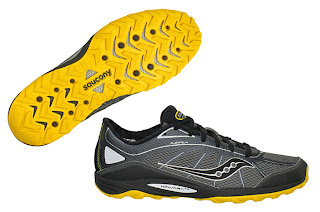
    Since I started running on trails, and mostly after the Copper Canyons Ultra, I realized that there is terrain that requires a sturdier protection for my feet. Sharp, protruding rocks are unforgiving, and I think rock-plating has its place in a serious trail shoe’s feature list. Sadly, most rock-plated footwear I have tried so far comes with thicker, elevated outsoles and some unwelcome heel-to-toe drop, which contributed to, if not caused, an ankle sprain some weeks ago. The Saucony Kinvara Trail is a rock-plated trail runner, but it features a low-to-the-ground approach and a slight 4mm drop, which intrigued me enough that I purchased a pair.


    First impression
    The Kinvara Trail looks and feels like a tough shoe, but remains very light. It features an aggressive outsole with v-shaped patterns and a solid rock-plate, completed by a double row of cylindrical studs that resemble ice spikes. The upper mesh is light and breathable and the tongue, partly sewn in place, is secured by a standard lacing system. Nothing out of the ordinary, no otherworldly feature here, which is one of the main reasons for my interest. The Kinvara Trail just plain looks solid.


    Trail test
    There’s no other way to know if a trail shoe has what it takes. I simply laced them up and went for a run. And another. And another. From light gravel trails to single track, the Kinvara Trail has performed admirably. So far, I have worn them on rocky trails covered with wet autumn leaves, muddy dirt tracks, in the gnarly Copper Canyons of Mexico and on rocky technical trails in Texas. In every environment, the shoe proved grippy and tough, and also comfortable over long distances. There’s no other way to put it; I love it.


    Conclusion
    I think Saucony has just created one of the best trail running shoes on the market right now. It does everything brilliantly, without exotic bells and whistles. Just common sense; it’s light, low, rock-plated, grippy, flexible and comfortable. The only little qualm I have about it is that the lacing has too many grommets for my taste, and that makes the shoe a little finicky to tighten properly. But this is easily fixed by changing the lacing so it skips every second grommet, then snipping the laces.


    High points
    • I won’t hide it : I love this shoe
    • Aggressive outsole is very grippy
    • Rock-plated, but remains very flexible
    • Light and minimalist


    Low points
    • Aside from the lacing micro-issue, I have nothing else to point out.