Showing posts with label shoe. Show all posts

September 20, 2017

Review : Merrell Trail Crusher

  • Type : Neutral
  • Use : All-terrain
  • Price : $100

Intro
A couple weeks ago, if you’d asked me whether a jack-of-all-trades, all-terrain shoe was fit for trail running, I would’ve said no with quite a bit of assurance. Pretty much any shoe of that type that I’d seen before presented the same problem; an outsole too stiff and hard, designed to resist the wear of pavement, which made it unfit for the trails, where grip is key. That was until I tried the Trail Crusher.

Merrell has been making some excellent running shoes, with models such as the Bare Access and its Trail version (probably one of the very best trail running shoes made in recent years, in my opinion). Lately, they had seemed to have gone the maximalist route, with shoe models offering more and more stack height and cushioning, as seems to be the trend these days, and which was a huge disappointment to all the neutral-type shoe enthusiasts.

Well, it seems they are back on track with the Trail Crusher, with a reasonable cushioning of 18mm to 14mm, heel to toe and a drop of 4mm which should suit a large swath of runners. Although not the lightest of shoes, they kept the weight down to a decent 12oz and the shoe does feel a little heavy when you weight it, but that feeling disappears when you actually put it on.

Road test
I started testing the Trail Crusher on asphalt, as it is my personal nemesis. The hard surface kills my knees and requires me to use more cushioning than I’d like, making my choice of road shoe even more tedious and difficult. I want nothing to have with motion control or density variations in the sole, which even further limits my choices.

The shoe felt light and nimble, and as the miles piled up, provided enough protection against shocks to make me feel comfortable for going a little longer. In fact, I started to think that the Trail Crusher, despite its name, would probably turn out to be much more of a road runner than anything else.

Trail test
Then I headed for the trails. Although admittedly they were not the most technical, they still offered some roots, uneven footing, some loose rocks and various other hazards requiring at least some level of grip and agility. I was very pleased to find out that the outsole’s design, which doesn’t really look like a hardcore nubby trail shoe, actually works really well and retains surprising proprioception for a relatively-cushioned shoe. The bubble-looking tread concept has probably been borrowed from the hiking department, as I’ve seen very similar-looking soles on Merrell products before. My only worry is how the Trail Crusher will retain its grip with the eventual wear of the oval shapes, but that remains to be seen.

Analysis
With its decent flex, reasonable weight and no-nonsense design, it seems that the Trail Crusher has successfully combined the requirements to be both a road and a trail shoe, which is quite a feat, and excellent news for budget-weary runners who enjoy a variety of terrains. Merrell’s signature wide toebox and some reinforcements at both ends of the upper complete an intelligent design and impressed me almost as much as the Bare Access model, enough so that I will be buying extra pairs just in case they would choose to stop production before my first pair wears out.

Conclusion
If you run on multiple surfaces, enjoy light neutral shoes without excessive cushioning and don’t want to own 15 different models of footwear to cover every type of terrain you run on, the Trail Crusher is an excellent contender, very well-designed and reasonably-priced. As far as all-terrains go, it doesn’t get much better than that.


High points
  • In line with Merrell’s previous designs like the Bare Access
  • Sole design actually works on all terrains
  • Pretty good pricing

Low points
  • Not sure how the grip will be when the outsole starts to wear out
  • Heel cup is surprisingly high and reaches above usual on my Achilles tendon


April 21, 2015

Review : Inov-8 Roclite 295

 
    • Type : Neutral
    • Use : Trail running
    • Price : $120-$130

    Introduction
    This is the third Inov-8 shoe I get to run in, and the second I review after the Race Ultra. I've always been impressed with the Inov-8 feel and its extreme expression; when I wear these shoes, I feel like a pro! The combination of grip and responsiveness is only matched, in my opinion, by a few top-of-the-line trail shoes such as the now-defunct Kinvara Trail from Saucony or my beloved (and also now-defunct, dammit) Altra Lone Peak 1.5.


    Trail Test
    This time around, the shoe feels light and quick, much more like the 235's I'd tried the first time. Unlike the Ultra, which definitely feels like it was made for a more cushiony ride over rough terrain, the 295 brings the aggressivity back while maintaining a great level of comfort. The shoe feels slim and long, with a lot of room at the tip but not so much on the side. When you lace up, you can feel how plush the upper is and I immediately thought how great that feeling must be while changing shoes in the middle of a long race.


    Analysis
    While certainly not a minimal shoe, the 295 doesn't overdo it and remains swift and nimble. The extra material between your foot and the ground becomes a great advantage if you're going to run long on terrain that switches from trails to pavement, for example, or if you're looking for a good overall winter running shoe. The grip is as good as always, with the outsole material soft and sticky. If you're looking for a firm grip in a comfortable shoe, this is it.

    Conclusion

    While this is pretty much the bulkiest shoe I'd wear out there, I have to say there's a lot of things the 295 does well. The feeling of sturdiness and protection you get can be a great plus for beginning trail runners or to get yourself back together after some hard distance on rough trails. The 9mm drop is the only thing I wish was different; why does it have to be so steep? I'd give it all A's if it had, say, 4.

    High points
    • Excellent grip as always
    • Nimble and swift despite added material
    • Super comfy

    Low points
    • 9mm drop is just too much
    • Tiny laces make it real easy to overtighten the shoe


    October 24, 2014

    Review : Inov-8 Race Ultra

    http://www.inov-8.com/new/global/Product-View-RaceUltra-290-Black-Blue-Mens-AW14.html
    • Type : Standard
    • Use : Trail running
    • Price : $130

    Introduction
    I tried my first pair of inov-8 shoes in the Arizona desert and was immediately impressed. I loved the underfoot protection and the grip, while the shoe, overall, felt light and fast. I wore it only two or three times, because when I got to Urique, I realized my Raramuri friend Javier had torn through his last pair of shoes. “Try these ones”, I said, handing out my Trailroc 235’s. He keeps the shoes that he likes; needless to say, I never got to wear them again :)

    When my Race Ultra came in the mail, I was a little surprised to see how much thicker it was, and the 8-mm drop worried me a little bit. The shoe itself felt awesome in my feet and reminded me of the La Sportiva Cross Lite, one of the staples in my shoe cabinet. I had a race coming up, so I thought “Let’s try something new!”

    Trail Test
    I took the inov-8’s to the gorgeous Pandora 24 course, out here in Quebec. It’s one of the most technical terrains we have available, with ever-changing ground that swings from muddy mess to rocky pitches, and everything in-between.

    I immediately felt that this shoe is built for the long run. What it loses in ground feel, it gains in overall comfort. This is way more cushiony than what you might expect of an inov-8, yet the added height doesn’t get in the way. Typically, and that’s what I usually dislike about thicker shoes, a bulkier outsole elevates my foot too much away from the ground and I end up twisting an ankle.

    The grip is as good as it gets; whether I jumped down on shaky rocks or quickstepped through slippery mud, my feet never slid. I felt secure and in control. This is a key element for me, as it allows me to build enough confidence to increase or maintain speed over trickier segments in the trail.

    My mudcaked Race Ultras, after a go on the Pandora course
    Analysis
    I have yet to run an ultra in these shoes, so I can’t say for sure whether the added cushioning proves relevant in the long run. After two hours in the woods, and on a fairly wet day, I was happy with the grip and the stability of the Race Ultras, although I did miss a little bit of the fast and nimble feeling I experienced with the slimmer, meaner Trailroc.

    The lacing is precise and the upper material allows for enough extension that you don’t need to re-lace in the middle of your run. This is a true trail shoe, no doubt about it. Plus, with fall in full effect and winter at the door, I get the feeling the Race Ultra will be my shoe of choice for winter running, with its great combination of grip, thicker sole and a beefier upper.

    Conclusion
    If you like to have a wide choice of shoes to choose from, I think the inov-8 Race Ultra could definitely find a spot in the thicker, souped-up end of your range. It is definitely built for long outings, while still offering outstanding grip and stability, something not a lot of shoes in this segment can gloat about. Moreover, if you have to deal with winter running, the Race Ultra has everything you need to keep warm, standing upright and smiling… through your frozen beard ;)

    High points
    • Excellent grip
    • Upper material is flexible and comfy
    • Behaves admirably on varying terrain
    • Very likely to become my winter running shoe of choice
    • “Ethical approach” to manufacturing which respects both workers and the environment

    Low points
    • Bulkier than what I usually wear
    • I would’ve liked a 4-mm drop option


    The equipment for this personal review was supplied by inov-8, free of charge, without any conditions.

    August 7, 2014

    Review : Skechers GoMeb Speed 2

    http://www.skechers.com/style/53925/skechers-gomeb-speed-2/bkgr

    • Type : Neutral shoe
    • Use : Road running
    • Price : $115


    Introduction
    The GoMeb Speed 2 is the next generation in the GoMeb series. The shoe is designed with competition in mind and feels like a more cushioned version of a traditional racing flat. Like its predecessors in the “Go” series, the outsole features the pod system, which is intended to offer some slight motion control without the use of complex mechanisms. The presence of the signature “stability plate” inside the sole almost questions if this shoe can be deemed neutral, but the overall lightweight and flexibility leave little to ponder about the GoMeb’s minimalist design philosophy.

    Road test
    When I tested the first model, I’d taken the guess that the GoMeb would be suitable for long runs on roads, which sadly I couldn’t try for myself since my feet inexplicably changed sizes last year. So this time around, I took the GoMeb Speed 2’s exclusively on longer runs, namely a 30K daily commute to and back from work.

    The speed sensation and lightness are definitely the key elements of the shoe. I also very much liked the new construction of the upper, which feels like they applied a flexible varnish on the pressure points to make them stronger. Add very minimal stitching and you get a shoe that is ultra light, ultra flexible and very comfortable.

    Analysis
    There are really good things about Skechers that apply to almost all their products. The Resalyte material is the most obvious; a feather-light sole material that has just the right bounce without taking anything away from total flexibility. In this perspective, the GoMeb delivers fully.

    The pod system, called GoImpulse sensors, however, had a strange effect on my feet. It seemed some of the pods would push up through the sole against my arches and cause some aches over longer distances (60K and beyond). This was confirmed when I wore the GoMeb’s daily on a recent trip to Europe, which involved long hours of walking and standing.

    Although I think the pod system is clever and well-placed in more supportive models like the GoRun, I’m not sure what it delivers in a shoe that has speed in its DNA. By definition, if you buy and use racing flats, you don’t require the shoe to have any form of motion control. Stability should not be a component of a racer; flex and freedom should be put forward.

    With that said, I think the GoMeb Speed 2 is an excellent shoe for shorter road runs, in the 5K to half-marathon range. It has more material under your foot than a typical racing flat, which adds a welcome addition of comfort without feeling any more bulky. I will definitely keep and use it for fast road races and shorter daily commutes.

    High points
    • Resalyte, as always
    • Simply built, yet very comfortable
    • Comfier than a pure racing flat
    • Can’t argue with the price tag

    Low points
    • The use of the pod system is questionable


    The equipment for this personal review was supplied by Skechers, free of charge, without any conditions.

    April 29, 2014

    Review : Altra Lone Peak 1.5


    • Type : Neutral
    • Use : Trail
    • Price : $115-130
    Intro
    I discovered Altra shoes while having a couple drinks and snacks at my friends the Miller's after a run. We were talking about the excesses of the “maximalist” movement, where shoes get more and more padding to appeal to the tired feet of long distance runners. Someone produced a pair of Altra Lone Peaks to make a point that there were shoes out there which offered significant padding, but followed some of the basic principles of “minimalist” running, too. No need to say, they got my attention.

    First test
    I had a long run scheduled shortly thereafter and received my Lone Peaks on the day I was leaving, which left no room for second thoughts. If I was going to wear those shoes in my Grand Canyon rim-to-rim-to-rim adventure, I had to be dead sure they wouldn't cause issues. The day before our traverse, we went out for a couple-hours hike down the south rim; that was my chance. I tried out the shoes, hiking for several hours, and was very pleased with the comfort, super wide toe box and soft ground feel. I was convinced enough to wear them the next morning.

    Long-distance trail test
    We started our adventure before daylight, which means some unsure steps along a very steep downhill in the semi-darkness. Immediately, I felt at ease in the Lone Peaks. They are grippy and feel very secure, yet their soft sole leaves all the room you want for foot flexing and ground feel. Being zero-drop, they didn't alter my running form in any way and their low weight, impressive considering the amount of material in the shoe, made me feel as quick-stepped and light as in any other, more minimal shoe I usually wear.

    Not too shabby for a test lab :)
    But the Lone Peaks started to really shine when the miles piled up. Beyond twenty miles of fast downhills and gruelling climbs, I expected my feet to start getting tired and beat up. Not at all. The cushioning is thick and soft, and my feet felt so fresh that it was hard to believe, considering the terrain we were navigating.

    More miles and more fatigue, and still the shoes felt great. I was a little worried that the very wide toe box would cause significant inner friction. On the contrary; the ample room left my toes free to move and I didn't feel any hot spots. I didn't have to lace too hard either, so no blood circulation issues, even when my feet inevitably swelled up from the hours of beating down the dirt paths.

    I emerged back on the south rim over sixteen hours after I had started, and couldn't repress a wide smile when I took the Lone Peaks off to find no blisters whatsoever, no hotspots and no bruising. This shoe, I tell you, is an absolute keeper.

    Analysis
    Altra has definitely found an equilibrium between comfy cushioning and firm ground feel. The Lone Peak doesn't go over board like the ultra-cushioned extravagant Hoka, yet provides such a smooth ride that you can wear it for hours on end and still feel great, protected and close to the ground all at once. The soles are grippy and firm, never slipping, sliding or rolling. I even tried a couple pretty stupid steps on sketchy scree, wet rocks and other perils and I never lost grip. I felt confident and could focus more on the beautiful nature that surrounded me, instead of wearily scanning the trail to pick my way at every step. I finished a pretty gruelling adventure with fresh feet, and a huge smile on my face.

    Conclusion
    The Altra Lone Peak is an awesome trail shoe perfectly fit for long distance running on a wide variety of terrains. If you train in lightweight minimal shoes and are looking for a comfier ride for your trail ultras, look no further. The wide toe box lets your toes move freely, while the upper and the lacing fit snugly around your foot. The grip is perfect and actually added to my confidence on the trails. The cushioning is what really sets this shoe aside (and I would say above) the competition for its fantastic comfort while not taking anything away from ground feel and flex, which really made me wonder how I would ever run another ultra wearing anything else.

    High points
    • Thick, comfy, excellent cushioning
    • No compromise on flex and ground feel
    • Zero-drop conception doesn't alter your running form
    • Light weight
    • Neat extras, like a built-in velcro attachment for gaiters

    Low points
    • Probably too padded for an everyday trainer


    October 10, 2013

    Review : Skechers GoRun Meb Speed


    • Type : Neutral shoe
    • Use : Road running
    • Price : 110$

    Introduction
    Meb Keflezighi is seriously fast. He's been working with Skechers for a while now, first in designing the GoRun and then his own signature shoe, which resembles a racing flat version of the typical Skechers models. The shoe is low, super light and looks like it's on fire. Will it make me faster?

    Road Test
    My favorite Skechers shoe, design-wise, was the GoBionic. I thought it offered the lightest, fastest feel of the family - until I tried the Meb Speed. This shoe is very, very light, but it offers some interesting features which add a certain stiffness to it that I really like.

    I took my Meb's out for several shorter runs on road and concrete pathways. They are light and feel fast, just like agressive racing flats. They offer a little bit more cushioning, too, which makes me thing they would be a better choice for a longer run, like a road ultra.

    Once again, the Resalyte sole material delivers fully, as it offers great flexibility and proprioception, yet cushions your foot just enough for great comfort. The overall weight of the Meb Speed is a featherly 6 oz and the upper fabric feels breathy and light.

    The outsole features a pod system called GoImpulse Sensors that resembles other Skechers models, but is much lower and less in the way. The big difference with the Meb Speed is the «stability plate» located under the arch, which attracted some negative comments from other runners and bloggers. In all honesty, I can't even feel it; the only thing that bugs me a little bit is the gaping hole under the plate, which acts as a rock sucker. But other than that, the shoe feels awesome.

    Analysis
    The Meb Speed is a fine addition to Skechers' line of running shoes. It offers the best of a racing flat while still featuring minimal cushioning for long road rides. The fit is perfect and the shoe feels fast and solid. This is definitely my new shoe of choice for road racing. On a slightly irrelevant sidenote, I wore my Meb Speed's for a desert ultra marathon a couple weeks ago... and they are not a trail shoe.


    High points
    • Resalyte. 'Nuff said.
    • Light and fast
    • Solid feel

    Low points
    • Outsole hole is a rock sucker


    The equipment for this personal review was supplied by Skechers, free of charge, without any conditions.


    May 27, 2013

    Review : Skechers GoRun2

    • Type : Neutral
    • Use : Road running
    • Price : About $80-90


    Introduction
    This is the third Skechers shoe I get to review. The two previous models showed some promise, but also carried some flaws that prevented me from choosing to use the shoes after the review. The original GoRun was one of these models, so when I received a pair of GoRun2, I thought maybe I was in for a bit of the same.

    First impression
    The very first thing I did was flip the shoe and look at the sole to see if the “pods” were still there. Although there were still pod-like lugs, they did not look or feel like their oversized, protruding predecessors and were distributed differently around the sole. They resembled the rest of the sole pattern and went all the way around the forefoot area. Interesting.

    It also seemed to me that the shoe’s profile had been considerably reduced, although it kept its signature upward curve at the heel.

    Road test
    I did with the GoRun2 what I had with the original model; I took it out for a couple run commutes. Immediately after putting the shoes on, I noticed they had a very different feel, which was closer to wearing a light neutral shoe. No more feeling the slightly-elevated, slightly-supported arch that I had disliked in the GoRun. No more “tilt-backward” feeling from the curved heel, either.

    The slip-out insole got ditched early on
    I took my sweet time to test the shoe out, at first to make sure I wouldn’t get all sorts of weird aches as I would up the mileage. But I quickly realized the GoRun2 is a very different animal than the GoRun; it felt increasingly comfortable and performed very well, even in winter conditions.

    The only thing that went sideways (literally) is the insole, which was sliding out of the shoe as I ran, something I’ve never seen happen in any footwear. I was quick to throw the insole away, and I never looked back as the shoe is perfectly wearable without this mild annoyance.

    Long-distance test
    I grew fonder of the GoRun2 as I ran with it, and it became one of my first choices as a commuter. I also very much liked how the GoRun2 behaves when running fast, because I think it offers just the right amount of sole material to absorb the extra shock while remaining very light. My confidence in the GoRun2 increased enough that I decided to put it to an ultimate test; I wore them at the Ottawa Marathon yesterday.

    Since I began trail running and strayed further and further from the roads, I find it increasingly difficult to run long distances on pavement because the hard, regular surface takes a heavy toll on my legs and feet. It requires a clockwork-type movement repeated to infinity, as opposed to the irregular, side-stepping, root-jumping dance of trail running. Wearing the GoRun2 made it a breeze by reducing my fatigue and allowing me to run as hard as I wanted in the downhills without feeling the added shock to my lower body. And I have to add that, after testing 3 models of Skechers shoes, I have become a fan of Resalyte, the soft, yet solid sole material they use in all their models.

    Conclusion
    I think Skechers has finally built a shoe that is a serious contender in the road-running world and that should be considered by ultra road runners looking for a softer ride on their long distance outings. The GoRun2 is soft, flexible, light, roomy and breathable. As an all-around running shoe, I’d be hard-pressed to find it any major flaw. This is the one Skechers model I have included in my personal shoe selection and will continue running in.


    High points
    • Resalyte is simply one of the best sole materials I know
    • Roomy toebox allows for ample toe splaying
    • Surprisingly grippy for winter road running
    • Comfortable for both speed and long distance


    Low points
    • Just ditch that annoying insole


    The equipment for this personal review was supplied by Skechers, free of charge, without any conditions.

    December 28, 2012

    Review : VIVOBAREFOOT Ultra


    • Type : Barefoot
    • Use : Multi-use
    • Price : $100


    Introduction
    The VIVOBAREFOOT Ultra is not a running shoe, per say. It sure wasn’t intended as such by the company, but it presents features close enough to other models like the Evo II. It didn’t take more for some runners to give it a try.

    Obviously, the Ultra is a multi-use shoe with water sports in mind. Its outer part is completely made out of a very soft rubber with a hollowed-out honeycomb pattern that makes it light, flexible and impervious to wet environments. Its most interesting feature is the possibility of removing the neoprene inner part of the shoe, which makes the Ultra a real Transformers-type footwear that outdoor enthusiasts will love.


    Outdoor testing
    I first used the Ultra as a camping shoe. In warm weather, I used only the outer part as a barely-there layer between my feet and the ground. It’s so breathy that it feels as light as a sandal. Then, when the temperature would cool down, I would add the neoprene part to keep my feet toasty and nice around the campfire or while walking around in dewy grass. I also liked that I could use the neoprene part only as an “indoor” shoe while in a cabin or shelter, as it has its own little micro-outsole. Then, when going out, I’d just slip my feet into the rubber outer part and be good to go.


    Hiking
    If you’re looking for longer-distance walking, I suggest you make sure you can be comfortable barefoot inside the Ultra. I found out with a little disappointment that I have to wear socks if I am to wear my Ultras for distances over 2km (say, walking more than 20 minutes). If I don’t, my Achilles get blistered. Bummer. However, I have gone on light to moderate hikes in my Ultras and found them very comfortable, decently grippy and very flexible, offering a great level of proprioception.


    Running
    I haven’t done any serious running in the Ultra. However, I think it’s fantastic that the shoe offers just enough features similar to a lightweight barefoot running shoe so that you can run in them pretty much anywhere, pretty much anytime. Which brings me to my next point.


    Casual wear
    This, to me, is where this shoe really stands out. I was sent the black-colored version which, although funky from its honeycomb-patterned top, is far from an eyesore and quite neutral-looking. It won’t look stupid when worn in the workplace (say, with a pair of jeans) and offers the best of barefoot-type wear, a blessing for office-dwellers like me. And when I go out at lunch and run errands, well, I can really run them! I have a very pedestrian lifestyle and often run short distances in my everyday clothes and this shoe is truly ideal for that purpose.


    Analysis
    The Ultra is a great all-around option for anyone looking for a barefoot-type shoe not uniquely focused on running, but that you can wear on a run, too. Enthusiasts of the concept, usually ultra-minimalists, will wear them over longer distances and I’ve even crossed a guy at the Montreal Marathon this year who ran in them the whole way. To me, the Ultra is great because it can do so much, I can wear it casually and I can transform it to fit whichever activity I’m doing. For the same reasons, it’s a very good shoe to travel around with.

    As a side note, I've never used the "tongue" bit provided with the shoe, and it is not at all essential to my comfort.


    High points 
    • Super light and flexible
    • Quickly transforms 
    • Neoprene inner can be worn separately 
    • Great all-arounder


    Low points
    • Can’t quite wear them without socks (is it just me?)


    The equipment for this personal review was supplied by VIVOBAREFOOT free of charge, without any conditions.

    December 20, 2012

    Review : SKORA Base


    • Type : Minimal
    • Use : Road running
    • Price : $110


    Introduction
    I became aware of SKORA earlier this year. At a time where many different makers come out with many different proposals, I was intrigued with their design almost as much as with their slogan, “Run Real”. The introduction text on the website sounds much like the book Born to Run and doesn’t include any specifics on how exactly SKORA shoes help you perform or favour what they call “real running”. Fast forward a couple months and a pair of their Base model landed on my desk.


    First impression
    Right out of the box, the shoe features a couple elements that attract the eye. The overall design is close to what now seems to become a standard in minimal shoes – slightly curved inward, flat interior with a removable insole and wide toe box. It uses an x-shaped Velcro system on the top, but also a heel strap that reminded me of the Vibram FiveFingers or the Saucony Hattori. The fabric around the foot is very soft and feels like a thermal sweater, which made me think this shoe was designed for a barefoot wear. Last but not least, the sole has a bizarre double-rectangle pattern on the front, and a somewhat elevated shape at the heel. The Base is not a super lightweight either, at 7.9oz, which came as a surprise.

    The purported use for the shoe, according to the web site, is road, gym and triathlon. How a triathlon differs from road use, I couldn’t say. Also kind of surprising to me is the overall height of the shoe, at 13mm including the insole, which is sensibly higher than, say, an EVO II from Vivo (5mm) or a Road Glove from Merrell (4mm).


    Field test
    I wore the Base for a couple short runs (5-6km), at first wearing socks. I took the insole out right away to make the shoe as minimal and as low as possible. It felt heavier than the other barefoot-type shoes I use regularly, but performed like any other should. However, I have to say that even on short distances, my proprioception was hindered by the sole design, which feels thick and unresponsive. I could feel the rectangle patterns in the front and the shape at the heel and it bugged me a little bit, mostly because I couldn’t figure out what advantage they bring.

    Then I went for a longer run. Past the 10k mark, the weight of the Base became more noticeable and I started to wish I could tighten up the shoe way more. The x-shaped Velcro strap is approximate at best and offers little control, which resulted in a sloppy feel for me and warning lights for blistering past 15K. As for other shoes offering a heel strap, I couldn’t feel any difference whether I adjusted it loosely or at maximal tightness. More bothersome was the sole design, which felt increasingly bulky and uncooperative as I went farther, plus the “rolling” effect I felt probably because of the up-curve around the heel block.


    Analysis
    With today’s offering in the minimal segment, I can’t see what SKORA brings to the table with the Base. The overall design is similar to many others, plus the shoe is heavier and higher than its rivals. The control over the tightness is very limited and the x-strap didn’t work well for me. On the upside, the fabric section at the heel, under the strap, is a great idea and adds to the shoe’s flexibility.


    Conclusion
    At a price point of $110, and with little to offer in terms of innovation, the Base would not be a top choice for me.


    High points 
    • Quite unique in terms of looks

    Low points
    • At 7.9oz, not a lightweight
    • 13mm sole (9 without the insole) is thick for a minimal shoe
    • X-shaped strap offers little control
    • Sole design is questionable


    The equipment for this personal review was supplied by SKORA Running free of charge, without any conditions.

    December 7, 2012

    Review : Saucony Kinvara Trail


    • Type : Minimal
    • Use : Trail running
    • Price : About $120


    Introduction
    Since I started running on trails, and mostly after the Copper Canyons Ultra, I realized that there is terrain that requires a sturdier protection for my feet. Sharp, protruding rocks are unforgiving, and I think rock-plating has its place in a serious trail shoe’s feature list. Sadly, most rock-plated footwear I have tried so far comes with thicker, elevated outsoles and some unwelcome heel-to-toe drop, which contributed to, if not caused, an ankle sprain some weeks ago. The Saucony Kinvara Trail is a rock-plated trail runner, but it features a low-to-the-ground approach and a slight 4mm drop, which intrigued me enough that I purchased a pair.


    First impression
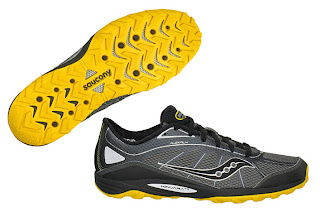
    The Kinvara Trail looks and feels like a tough shoe, but remains very light. It features an aggressive outsole with v-shaped patterns and a solid rock-plate, completed by a double row of cylindrical studs that resemble ice spikes. The upper mesh is light and breathable and the tongue, partly sewn in place, is secured by a standard lacing system. Nothing out of the ordinary, no otherworldly feature here, which is one of the main reasons for my interest. The Kinvara Trail just plain looks solid.


    Trail test
    There’s no other way to know if a trail shoe has what it takes. I simply laced them up and went for a run. And another. And another. From light gravel trails to single track, the Kinvara Trail has performed admirably. So far, I have worn them on rocky trails covered with wet autumn leaves, muddy dirt tracks, in the gnarly Copper Canyons of Mexico and on rocky technical trails in Texas. In every environment, the shoe proved grippy and tough, and also comfortable over long distances. There’s no other way to put it; I love it.


    Conclusion
    I think Saucony has just created one of the best trail running shoes on the market right now. It does everything brilliantly, without exotic bells and whistles. Just common sense; it’s light, low, rock-plated, grippy, flexible and comfortable. The only little qualm I have about it is that the lacing has too many grommets for my taste, and that makes the shoe a little finicky to tighten properly. But this is easily fixed by changing the lacing so it skips every second grommet, then snipping the laces.


    High points
    • I won’t hide it : I love this shoe
    • Aggressive outsole is very grippy
    • Rock-plated, but remains very flexible
    • Light and minimalist


    Low points
    • Aside from the lacing micro-issue, I have nothing else to point out.

    November 21, 2012

    Review : Skechers GoBionic


    • Type : Minimal shoe
    • Use : Road running
    • Price : About $90


    Introduction
    I was left sceptical of Skechers’ ability to produce good running shoes after a first review of their GoRun model, which featured an outward-rounded midfoot section aiming to correct the landing position of heel strikers. However, I had been impressed with the Resalyte material of the sole, with the upper fabric and the overall quality of construction. So when they told me they had created a new, minimalist model using these same features, I was curious to see the result.

    First impression
    The GoBionic looks like a lowered version of the GoRun, but that’s pretty much where the comparison ends. At just under 6oz, it feels extremely light and features a removable insole for those wanting “as little shoe” as possible. The partly-hollowed outsole is not unlike the original Nike Free and flexes in every conceivable way. The “pod” idea is still present in the form of what Skechers calls “M-Strike Pads”, which are 8 zones strategically placed underfoot where the landing and toe-off occur. I was surprised to see that the heel area is still rounded upwards in what now seems to be Skechers’ signature profile, but the shoe is presented as “Zero-Drop”.

    Road Test
    I decided to take out the insole to lower the shoe as much as possible. With over 11 mm of padding, the GoBionic has plenty of material between you and the asphalt, even over very long distances. The first thing I noticed however, after taking only a couple of steps, is that the Resalyte sole material really delivers its promise; without being too soft, it offers a smooth, very comfortable ride. The grooves in the sole behaved exactly as expected and let the shoe flex and move in synch with my feet. And even though the GoBionic had that scary profile with the heel rounding upwards, it feels as good and natural as any other “Zero-Drop” shoe out there. Not bad. Not bad at all.

    Skechers GoBionic Shoe Review FlintLand
    M-Strike pads and
    grooved outsole

    The more I ran in the GoBionic, the more I liked it. Until it rained. The shoe revealed its only major flaw, which spawns from the fact that the grooves in the outsole go all the way to the bottom of the midsole. Even plain damp asphalt will make your feet wet in a couple minutes, as the flexing parts in the outsole seem to literally suck the water in. Less than a dozen steps on wet grass will soak your feet instantly, making the shoe a no-no for any trail running, no matter how light. Bummer.


    Conclusion
    I have run more than 200 km in the GoBionic so far and I will keep running in them for my office commute and road running in fair weather. I love how they ride and their featherweight feel, and I have to add that I like how the shoe “falls” on the ground (is it the pads?) without feeling like there’s a ton of mushy material between me and the action.

    High points
    • Resalyte sole material really delivers
    • Adapted to barefoot (no socks) wear
    • Super light, flexible shoe

    Low points
    • Will soak your feet in seconds on wet pavement
    • Not for narrow feet

    UPDATE. Skechers now offers a waterproof version of the GoBionic.

    The equipment for this personal review was supplied by Skechers, free of charge, without any conditions.

    September 24, 2012

    Review : Skechers GoRun


    • Type : Transition shoe
    • Use : Road running
    • Price : About $90


    Introduction
    Before I met one of their reps at a race, I didn’t know Skechers had hopped on the minimalist bandwagon. As a matter of fact, I knew little about the company, except for the Shape-Ups models that left me dubious, to say the least. The rep explained that the GoRun was a shoe intended to help runners transition from a heel strike to a more natural, mid-foot strike pattern and suggested I try them for myself. I took a couple steps in them and was unconvinced, but curious. So I decided I would give them a real try.


    First impression
    This shoe has a unique design with the outsole curving upwards at the heel and 9 “pods” at the mid-foot, which elevate and curve it downwards. The idea here is that if you try to heel strike, the GoRun will correct your posture by “rolling forward” to your mid-foot, thus theoretically helping you adopt a more natural stride.


    Road test
    I ran two times with the GoRun. The first, a 5k commute, left me feeling very strange because of the elevated arch and the presence of the “pods”, which I felt impeded my forefoot strike. On the second run, the way back home from work, I had to take the shoes off at 3K and finish barefoot, because my arches hurt and my stride was totally off.


    After discussing with the Skechers rep again, it became quite clear that this shoe is not made for runners who have a forefoot strike, which means it is not a minimal or barefoot shoe, nor is it fit for anyone running with a barefoot form. That left me with the problem of properly reviewing the GoRun, until I had the idea of asking heel strikers to give it a go at the running track, and see how they felt about it.


    Track test
    Without telling them my intent, I asked a range of runners to run a 400M lap with their standard shoes, than one barefoot, than one wearing the GoRuns. I wasn’t overly surprised with the results; the shoe only seemed to work well with heel strikers. They reported they could feel the shoe “roll” forward which, in turn, made them shorten their stride. They weren’t bothered with the arch section, probably because they are used to such “supports” in their conventional footwear. They were delighted with the shoe’s feather weight and with the sole material, which is very soft and flexible.


    Shod runners with a natural form (mid-foot to forefoot strike patterns), on the other hand, were left dubious and reported they felt the arch section was “weird” at best, “impeding” in the worst cases. Aside from the sole, they liked the GoRun’s design and often compared it to the original Nike Free model.


    Analysis
    I didn’t notice a big change in the heel strikers’ postures, aside from the shorter stride. I was shocked, however, to review pictures from my natural runners, whose form was negatively altered in all cases. It seems the thickness of the outsole and its design had a negative impact on the natural runners’ form; it lengthens their stride and brings back a heel strike-like pattern, with the “roll forward” effect happening on the outside of the shoe, causing an under pronation. The example below illustrates the differences in form in a natural runner :

    First, running in her usual Saucony Kinvara :


    Second, barefoot :


    Third, in the GoRun :


    Conclusion
    It became quite clear, during this test, that the GoRun is not recommendable to natural runners who have already learned to land on their mid-foot or forefoot. The elevated arch section, rounded heel and “sensor pods” will only impede proprioception and change their landing patterns.


    Heel strikers, on the other hand, seemed to be “pushed” toward a shorter stride, which makes them land closer to their center of gravity, certainly not a bad thing. However, this made me wonder: shouldn’t runners learn better form themselves, instead of relying on the design of their shoes? Isn’t that exactly the same issue as with orthotics?


    When all is said and done, learning good form is not only about where you land; it’s also about understanding biomechanics and making the conscious effort to kick off your shoes, re-learn proprioception and develop an improved muscular structure. But if all it takes to point you in that direction is a pair of GoRun to start your discovery of natural running, Skechers might have succeeded in creating a “transition” shoe.


    High points
    • Comfortable “Resalyte” outsole material
    • Lightweight
    • Roomy toe box
    • Might help the transition of heel strikers who don’t want to learn barefoot


    Low points
    • A mechanical solution, similar in principle to the use of orthotics
    • Elevated arch and “pods” impede a forefoot strike
    • Definitely not for barefoot / minimal runners


    The equipment for this personal review was supplied by Skechers, free of charge, without any conditions.

    July 30, 2012

    Review : VIVOBAREFOOT Breatho Trail


    • Type : Barefoot / Minimal
    • Use : Trail running
    • Price : About $120


    Introduction
    The Breatho Trail looks to me like the next evolutionary step from the Neo Trail model. Taking it out of the box, the first thing I noticed was that VIVO changed the lacing, something I had done early on with my Neo’s, whose ribbon-style eyelets are abundant and close together.

    The Breatho features the same “zigzag webbing”, but has only 3 contact points and one plastic eyelet, which works much better. The shoe’s tongue has a sewed-on weaving ribbon that allows the laces to go through at every contact point, making it impossible for the tongue to slide around while running.

    The sole has been modified, too. While it keeps the same lug pattern, it has less of the grainy, super soft texture of the Neo that wore so fast on hard surfaces. Only time will tell for sure, but the Breatho’s sole material looks like it’s going to last much, much longer, which is another welcomed improvement.

    First impression
    The Breatho runs exactly like the Neo Trail. It offers very good protection while allowing surprising proprioception (ground feel), feels solid on slippery surfaces and features a roomy toe box with a TPU toe guard that will help you keep your toenails where they belong. Protection comes with the price of added weight, however: at 9.6oz, it’s not the lightest minimal shoe around.

    Where I think the Breatho is superior is in the lacing; the improvements VIVO made over the Neo really impressed me. And if the sole does last longer because of the new material, I think the Breatho will impose itself as the de facto hardcore trail shoe.

    Trail test
    I ran in the Breatho over several types of trails, from gravel paths to gnarly technical single track. They provide a sure footing while maintaining the “minimal” or “barefoot” feel, which is not an easy feat. The Breatho succeeds where a lot of minimalist trail-wannabes have failed. The removable insole system allows the runner to play around with the level of cushioning (although minimal) they want, and offers the added benefit of making the shoe last longer. Last but not least, the upper fabric is definitely on the thicker side, a blessing for us trail runners who live in the cold and run through the hardships of winter.

    Conclusion
    With the Breatho, VIVO demonstrates that they can improve an already impressive shoe and deliver a solid choice for the serious minimalist trail runners out there.


    High points
    • Zero drop
    • Improved lacing
    • Aggressive traction
    • Excellent proprioception
    • Can be used for winter running
    • Replaceable / removable insole

    Low points
    • Waterproofing fades as usage increases
    • Puncture resistant, but not rock-plated


    The equipment for this personal review was supplied by VIVOBAREFOOT, free of charge, without any conditions.

    April 27, 2012

    Review : VIVOBAREFOOT Evo II

    Important
    Before transitioning to minimalist (or “barefoot”) footwear, make sure you understand what the whole concept entails.
    Here’s an intro text if you need it.


    • Type : Barefoot / Minimal
    • Use : Multi-terrain running
    • Price : About $130


    Introduction
    VIVOBAREFOOT presents this shoe as multi-terrain, a statement I found to be quite risky, considering how hard it is just to find a proper minimalist shoe with a single purpose. So, in order to analyze this model properly, I decided to test it on as many surfaces as I could get my feet on, and see how it reacts.


    First impression
    The Evo II feels a lot lighter than my Neo Trail shoe, weighting just under an ounce less. The material of the upper and the thinness of the outsole contribute to the feeling that this shoe is really trimmed down to the essentials. It has a cool "beehive" design, which makes it unique and very easy to recognize. Upon looking at them for the first time, though, I thought this shoe would only perform well on the road.


    The shoe
    Like many VIVOBAREFOOT products, this shoe is zero-drop, very low-to-the-ground (5mm) and ultra flexible. It allows for awesome proprioception and is one of the best shoes on the market in that perspective.

    One of the features I like a lot with VIVO are the removable insoles that allow to add / remove some level of protection according to your personal taste or the terrain you run on. This also means you can replace the insole with something beefier if you ever encounter tougher conditions, something that should be appreciated by runners who don't want to buy multiple pairs of shoes for different uses. The Evo II features a standard lacing system that works well, although I re-laced my pair to skip some of the eyelets which I thought were unnecessary. This shoe would work well with a pull-cord-type lacing system.


    Road test
    I loved this shoe on the road. It's so nimble and light that it truly feels like you are wearing nothing, yet it protects your feet from anything you could step on. I also suspect traceurs (parkour adepts) would go crazy with the Evo II and its awesome grip on various surfaces. The fabric breathes really well and lets the air through, and dries quickly if you make it wet. If you are a minimalist road runner, I enthusiastically recommend this shoe.


    Trail test
    I think the Evo II delivers surprisingly well in light trail conditions. If you run on packed earth, sand, grass or light gravel, no problem. It has plenty of protection, even without the insole. The amount of proprioception is great, so runners should have no problem in reacting to any type of ground they feel under their feet.


    Like any multi-purpose product, it's in the extremes that you find the compromise. The Evo II is not a real trail shoe, but then again it never pretended to be. If you run on technical trails, gnarly rocky paths and wet muddy rocks, there are other shoes better suited for that. The sole has good grip, but definitely not enough to tackle the hardships and surprises of single track trails.


    Conclusion
    If you are a thrifty minimalist runner looking for the elusive do-it-all shoe, the Evo II just might be the one. I'd suggest to simply buy an extra pair of sturdier insoles for your rougher trail outings. The Evo II is light, flexible, breathable and offers excellent proprioception. It is an excellent choice as a road runner and will deliver decent grip and protection under light off-road conditions. Add good looks and easy maintenance (just throw them in the washing machine) to all this and you get a very good all-around product that should last you for many, many happy miles.


    High points
    • Zero drop
    • Light and flexible
    • Excellent proprioception
    • Wide toe box


    Low points
    • European sizing makes fitting a bit tricky
    • Not suited for serious trail and single track


    The equipment for this personal review was supplied by VIVOBAREFOOT, free of charge, without any conditions.

    November 22, 2011

    Review : VIVOBAREFOOT Neo Trail

    Important
    Before transitioning to minimalist (or “barefoot”) footwear, make sure you understand what the whole concept entails.
    Here’s an intro text if you need it.


    • Type : Barefoot / Minimal
    • Use : Trail Running
    • Price : About $140 (unverified)


    Introduction
    There have been so many new products in the minimal / barefoot market recently, I find it hard to even keep track. It’s a blessing, on one side; because a wider choice is often a good thing (provided the offered products are well-conceived). On the other hand, there seems to be many crappy, confusing, nonsensical products which have hit the shelves, and they are not bringing anything of interest to the table (The Fila Skeletoe is just one example of the latter).


    So when I opened the box to check out the VIVOBAREFOOT Neo Trail, I did it with a healthy dose of scepticism. I had been searching for a viable shoe fit for serious trail running for some time now, and aside from the Merrell Trail glove (reviewed here), which is a sound choice but doesn’t offer enough grip for single-trail conditions and harsh terrain, I had found nothing.


    First impression
    I usually don’t analyze packaging or marketing, for obvious reasons, but I have to make an exception here. First of all, VIVOBAREFOOT uses recycled materials for some of the shoe’s parts, like the inner lining. Second, the shoes are guaranteed not to be produced in sweatshops, something commendable, which every apparel maker out there should be doing. Finally, your shoes come wrapped not in throw-away plastic or paper, but in individual, washable, reusable bags that work wonders when you have to carry your mud-stained shoes in a backpack.

    The shoe
    At 8,25 oz, the Neo trail is light but not a featherweight. This didn’t bug me, as the shoe feels tough and ready for action. It is built with a very wide toe box and a fairly flat end, something I think is now the proven way to go for any minimalist shoe. With that said,
    Linkhowever, the sizing is a little tricky, as it relies on the European charts and the shoes run about one size short. (For example, I’m typically a size 7.5 and was advised to get a size 42, which was too big and had to be replaced with a size 41).

    The lacing on the pair I got was done from the outside in, which I changed for a more straightforward, pull-to-tighten approach. The shoe doesn’t slim down at the arch section like other barefoot shoes do and leaves ample room for up to 7 diagonal rubber lugs on the outsole and a rock plate under the arch. This is where the Neo Trail really expresses itself: it screams trail.

    Trail test
    I wore the Neo Trails for a full day at the office before trying them out for a run (I’ve learned that trick from blistering experience). Turns out they didn’t need a break-in. Then I wore the shoes for an outside walk, then a light trail run, then a single-trail cross-fit run, and finally a full-fledge mountain trail run.


    The Neo Trail delivered beyond my expectations. At first, I thought the aggressive sole pattern would take away some ground feel for sure, but somehow it doesn’t. You will feel as much terrain as you do in a pair of VFF Komodos, but with the proper protection against protruding rocks and other trail hazards. I was amazed to step in deep mud and feel every inch of the experience, while in the meantime being able to run hard in very rocky downhills relying on the excellent protection of the rockplate and rubber studs.


    The grip of this shoe is amazing. I was lucky to run one of my tests with a Training Mobs group wearing regular running shoes and trail shoes and my Neo Trails outperformed the former and were definitely on par with the latter, if not better. The low-to-the-ground, zero-drop 6.5mm sole clearly puts you at an advantage while it not only lets your foot twist and turn like it should, but offers aggressive traction even on wet surfaces.

    The upper fabric seems to be truly 100% waterproof, as I stepped in puddles of water, mud patches and ran on trails thickly covered in damp leaves and never got my feet wet. This is fantastic for Canadian runners, as we have to face harsh snowy winters and slushy paths. The combined water resistance and traction of the Neo Trail makes it a serious choice for multiple running conditions throughout the seasons, something not a lot of minimal shoes can pretend to offer.


    Conclusion
    This is one solid trail running shoe, and thus far my choice when it comes to serious single-trail running. With the excellent proprioception of a true minimal shoe and the traction / protection of a standard trail runner, The Neo Trail offers the best of both worlds. I am very impressed with it and will keep using it for many more happy trail miles in the future.


    High points

    • One of very few serious minimal trail runners
    • Sturdy, yet flexible outsole with excellent traction
    • Offers plenty of protection on harsh single trails
    • Roomy toe box for free movement
    • Zero-drop construction with removable insole
    • Waterproof


    Low points

    • Sizing's a little tricky


    The equipment for this personal review was supplied by VIVOBAREFOOT, free of charge, without any conditions.